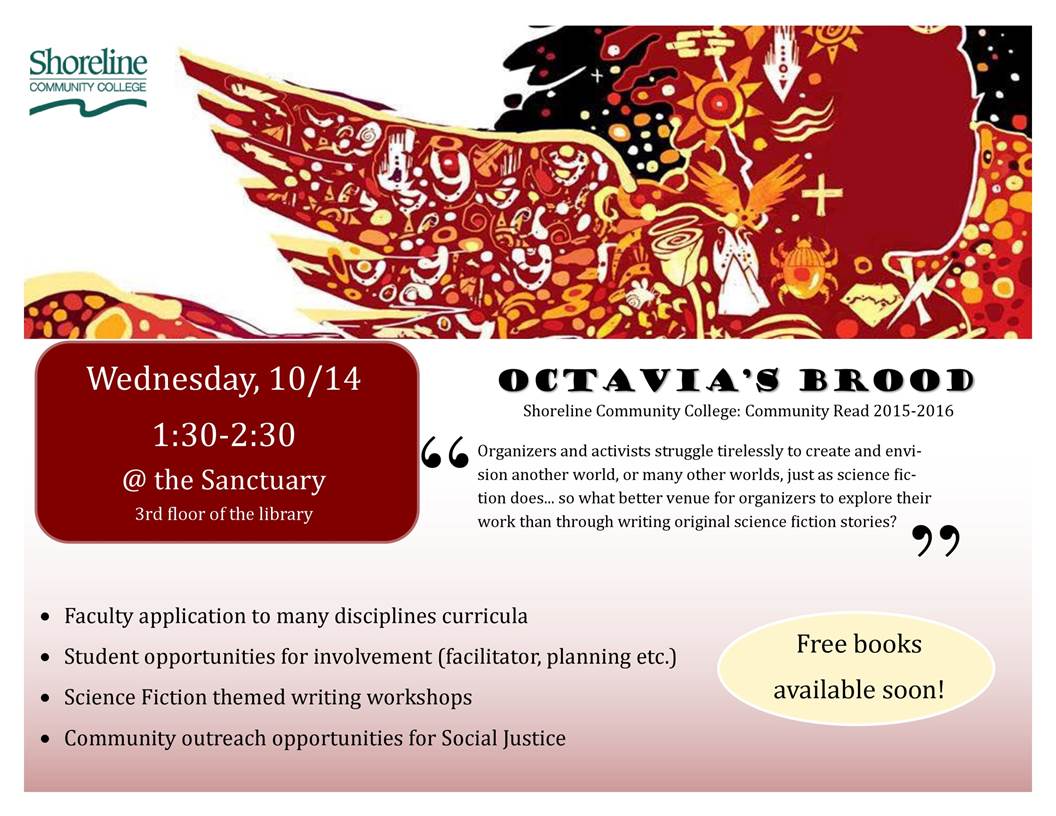
“Octavia’s Brood” Community Read Kick Off Event Wed., Oct. 14

octavias brood
This year’s Community Reads book, Octavia’s Brood, is a science-fiction/fantasy anthology inspired by the work of Octavia Butler and focused on themes of social justice (in many planes of time).

To kick off this semester’s community read, we’re hosting an Introduction to Octavia’s Brood event this Wed., Oct. 14 from 1:30-2:30 p.m. on the third floor of the library. Refreshments will be served. We’re going to display a webpage for community reads containing many resources for anyone interested in the book. We’re encouraging students, staff and faculty to attend and learn more about this book and the activities that will be planned around it in the coming year.

We’re hoping to get some students at the kick off interested in the topics of social justice, science fiction and creative writing to get involved with the book group portion for next quarter. We’re also hoping to get more staff and faculty involved in the read itself. If you’ve ever been interested in any of the above spread the word and we hope to see you there!

North sets fund to help bus-accident victims

In the aftermath of the tragic bus accident, the Seattle College District has received an outpouring of support and questions from people about how they can help. The district has established a fund to provide direct assistance to students, staff and their families affected by the accident. It is available here:  https://www.razoo.com/story/Bus-Accident-Support

Disability Employment Awareness Month Tip for Oct. 13: Facts About Dwarfism

In honor of Disability Employment Awareness Month, the Office of Special Services (OSS) is working to raise awareness of disabilities by offering daily facts and tips about people with disabilities and living with disability. Please take a minute to read and broaden your understanding.

October is National Dwarfism Awareness Month
Dwarfism is short stature that results from a genetic or medical condition. Dwarfism is generally defined as an adult height of 4 feet 10 inches (147 centimeters) or less. The average adult height among people with dwarfism is 4 feet (122 cm).

Many different medical conditions cause dwarfism. In general, the disorders are divided into two broad categories:

  • Disproportionate dwarfism. If body size is disproportionate, some parts of the body are small, and others are of average size or above-average size. Disorders causing disproportionate dwarfism inhibit the development of bones.
  • Proportionate dwarfism. A body is proportionately small if all parts of the body are small to the same degree and appear to be proportioned like a body of average stature. Medical conditions present at birth or appearing in early childhood limit overall growth and development.

Causes
Most dwarfism-related conditions are genetic disorders, but the causes of some disorders are unknown. Most occurrences of dwarfism result from a random genetic mutation in either the father’s sperm or the mother’s egg rather than from either parent’s complete genetic makeup.

Achondroplasia
About 80 percent of people with achondroplasia are born to parents of average height. A person with achondroplasia and with two average-size parents received one mutated copy of the gene associated with the disorder and one normal copy of the gene. A person with the disorder may pass along either a mutated or normal copy to his or her own children.

Turner syndrome
Turner syndrome, a condition that affects only girls and women, results when a sex chromosome (the X chromosome) is missing or partially missing. A female inherits an X chromosome from each parent. A girl with Turner syndrome has only one fully functioning copy of the female sex chromosome rather than two.

Growth hormone deficiency
The cause of growth hormone deficiency can sometimes be traced to a genetic mutation or injury, but for most people with the disorder, no cause can be identified.

Other causes
Other causes of dwarfism include other genetic disorders, deficiencies in other hormones or poor nutrition. Sometimes the cause is unknown.

The above information is from the Mayo Clinic.

Great Washington Shakeout drill at 10:15 on 10/15

Where will you be at 10:15 on 10/15 for the Great Washington Shakeout?

great washington shakeout

At 10:15 a.m. on Oct. 15, The Great Washington Shakeout drill

Wherever you are, Shoreline Community College will be sending a test message as part the college’s participation in this statewide earthquake preparedness awareness effort. The Great Washington Shakeout is scheduled for 10:15 a.m. on October 15 as part of a national program.

At Shoreline, college officials suggest three things to get ready for the Great Washington Shakeout:

  • HOLD ON to it until the shaking stops

In addition, demonstrations of Automatic External Defibrillators (AED) and Stryker evacuation chairs will take place from 11:30-12:30 a.m., Thursday, Oct. 15, in the lobby of the gym.

More information about the Great Washington Shakeout is at:

  1. http://www.dropcoverholdon.org/
  2. http://www.shakeout.org/washington/

Remember, this is only a drill.

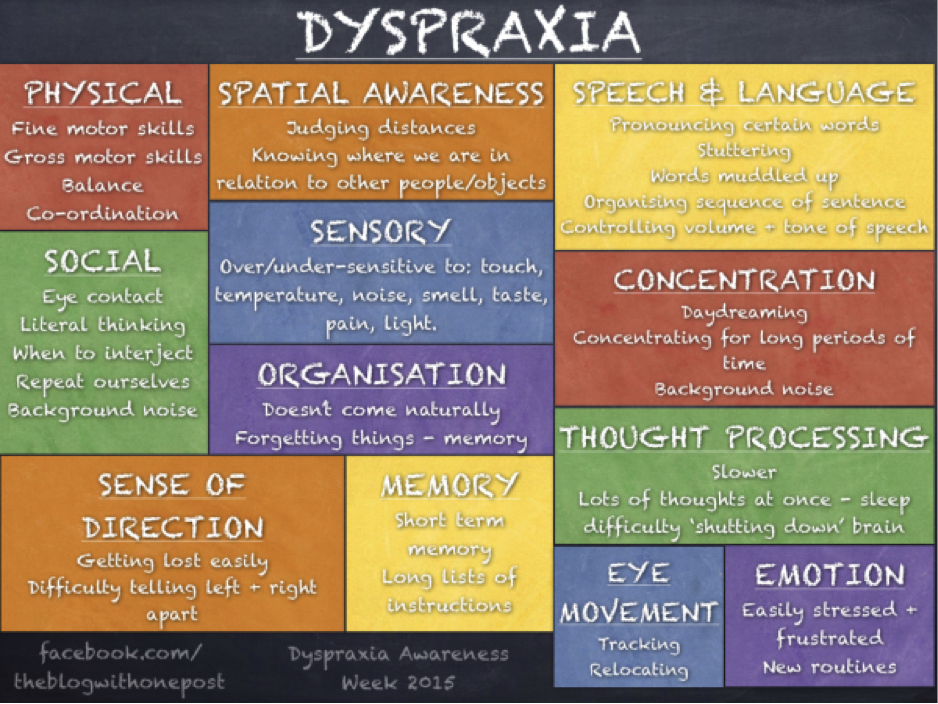
Disability Awareness Month Tip for Mon., Oct. 12: Understanding Dyspraxia

dyspraxia
In honor of Disability Employment Awareness Month, the Office of Special Services (OSS) is working to raise awareness of disabilities by offering daily facts and tips about people with disabilities and living with disability. Please take a minute to read and broaden your understanding.

Oct. 11-17 is Dyspraxia Awareness Week

What is dyspraxia?

Dyspraxia isn’t a sign of muscle weakness or of low intelligence. It’s a brain-based condition that makes it hard to plan and coordinate physical movement. Children with dyspraxia tend to struggle with balance and posture. They may appear clumsy or “out of sync” with their environment.[1]

Dyspraxia goes by many names: developmental coordination disorder, motor learning difficulty, motor planning difficulty and apraxia of speech. It can affect the development of gross motor skills like walking or jumping. It can also affect fine motor skills. These include things like the hand movements needed to write clearly and the mouth and tongue movements needed to pronounce words correctly.

Dyspraxia can affect social skills too. Children with dyspraxia may behave immaturely even though they typically have average or above-average intelligence.

Kids don’t outgrow dyspraxia. But occupational therapy, physical therapy, speech therapy and other tools and strategies can help. Kids can learn to work around areas of weakness and build on their strengths.

Different Kinds of Dyspraxia
Dyspraxia can affect different kinds of movement. Professionals you speak to might break it down into these categories:

  • Ideomotor dyspraxia: Makes it hard to complete single-step motor tasks such as combing hair and waving goodbye.
  • Ideational dyspraxia: Makes it more difficult to perform a sequence of movements, like brushing teeth or making a bed.
  • Oromotor dyspraxia, also called verbal apraxia or apraxia of speech: Makes it difficult to coordinate muscle movements needed to pronounce words. Kids with dyspraxia may have speech that is slurred and difficult to understand because they’re unable to enunciate.
  • Constructional dyspraxia: Makes it harder to understand spatial relationships. Kids with this type of dyspraxia may have difficulty copying geometric drawings or using building blocks.[2]

The above information was taken from and can be found on Understood.org.