Save the Date! Campus Accessibility Walk

Tour Our Campus with an Accessibility Lens.

The Accessibility Advisory Committee (AAC) invites you to this special event that will give you a new perspective on our campus environment.

We are fortunate to learn, work, and live on a beautiful campus, but beauty and accessibility don’t always go together. As we explore the campus, we will have the opportunity to identify physical barriers and discuss how we can make our spaces more inclusive for everyone.

Event Details:

  • When: Wednesday, May 13th
  • Time: 3:00 – 5:00 PM
  • Where: Meet in Room 4228 for pre-walk snacks and good conversation

Please join us for some fresh air and meaningful advocacy!

MMIWG Awareness Day

Poster for the National Day of Awareness for Missing & Murdered Indigenous Women & Girls (MMIWG). A red illustrated portrait of a woman is surrounded by red handprints. Text encourages people to wear red to honor stolen relatives and call for justice

May 5th is the National Day of Awareness for Missing and Murdered Indigenous Women and Girls (MMIWG). On this year’s MMIWG Awareness Day, we invite you to take part in a living memorial at the yəhaw̓ Center for Student Empowerment (PUB 9114) from 11 AM to 1 PM.

It will be a space to honor victims, support families, and raise awareness about the crisis of violence against Native women. We encourage everyone to wear red to help bring visibility to the cause and show solidarity with our Indigenous communities.

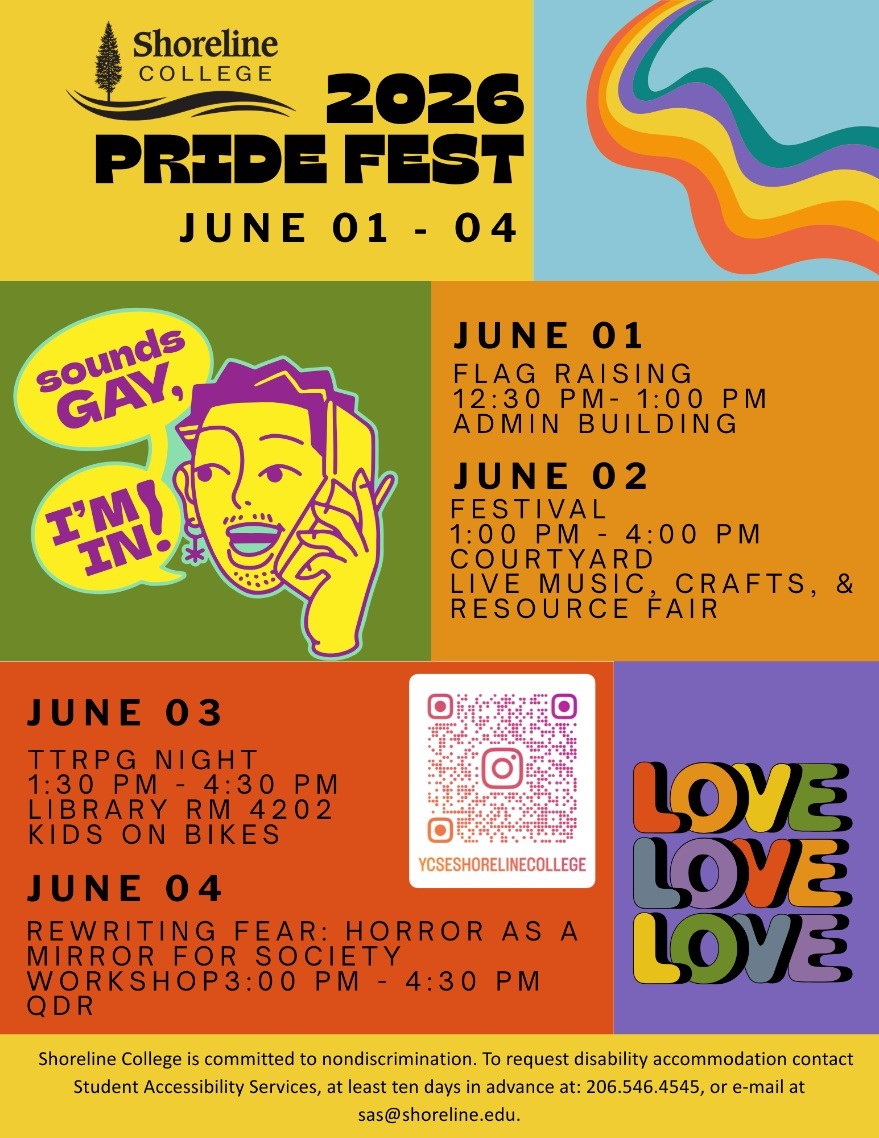
Queer Folks and Friends

Event flyer includes images of dolphins and a rainbow.

Queer Folks and Friends

Queer Folks and Friends is a monthly affinity group that provides a brave space for Queer folx and allies of Shoreline College to build and foster community. We aim to create an environment where folx feel empowered to show up as their truest and most authentic selves.

Meetings occur on third Friday of every month over Zoom.

Contact rlopez@shoreline.edu for more information.

A Message of Support to Our Campus Community

Dear Campus Community,   

As we begin the spring quarter, we do so amid deeply troubling events at home and abroad. In a recent public post, the President of the United States wrote, “A whole civilization will die tonight, never to be brought back again. I don’t want that to happen, but it probably will.”  Rhetoric that anticipates or normalizes the destruction of a people, their culture, and their history, particularly amid escalating threats of violence against Iran, stands in direct opposition to who we are as an institution and to our commitment to provide educational opportunity while expanding, celebrating, and learning from all human cultures.  While this rhetoric has already changed to a “two-week warning” these words still have impact. 

We want to be unequivocally clear: this college is home to Iranian faculty, staff, students, and community members. Iran and Iranian culture are part of the human community we value, protect, and learn from. To our Iranian community members, and to all who are affected by this moment: this is your space to learn, to work, and to be. You belong here.   

In a related effort to marginalize and erase lived experiences, the U.S. Department of Education has rescinded key Title IX protections for transgender-identified people. While Washington State has continued to provide more proactive and affirming support, this reversal at the federal level represents a deeply troubling retreat from the obligation to protect access, safety, and dignity in educational spaces. Such actions undermine the inclusive purpose of public education and signal whose identities and lives are deemed worthy of protection. At Shoreline we support the rights of our transgender students and staff and will continue to strive to provide an inclusive and safe learning and working environment for all. 

People often ask, “What can I do when these things happen in my community”? Often, the most meaningful place to start is with simple acts of care; checking in with a colleague, reaching out to a student, or being present for someone who may need support. 

One of Shoreline’s greatest strengths is the compassion and humanity of this community. In times marked by violence, uncertainty, and grief, that care matters. Our college is not only a place of learning, but a place where we can also hold space for one another with empathy and understanding. 

Should you or someone you know need support, please do not hesitate to connect with the following resources located below.  

CAMPUS RESOURCES 

Employees

Employees Assistance Program: Employees may access services and support at any time through the Employee Assistance Program (EAP) at 877-313-4455 (as provided by the Diversity Equity Officers Commission). Their service is confidential and free. We urge you to keep this number readily available in the event you or a colleague need to lean into this level of support.   

EAP is available and here for you, should you or a family member want or need support.   

As a reminder, EAP offers the following:  

  • Problem assessment and short-term counseling     
  • Referrals to providers and community resources     
  • Webinars   
  • Critical Incident Response       

Employees are also encouraged to contact Shoreline’s CARE team should you identify a student in need of support.    

Students

Students may access the following services for support:    

  • If you are experiencing distress related to this, please reach out to the Counseling Center for support.    
  • In addition, for emergency counseling, referral, or assistance 24-hours/day and 7-days/week, please call:
    • King County: Crisis Connections (Crisis Line) | 866-427-4747
    • Snohomish County: Volunteers of America Care Crisis Response Services (Crisis Line) 800-584-3578
    • Lifeline Crisis Chat: Go to suicidepreventionlifeline.org/chat/
    • Crisis Text Line: Text 741741     
    • 911 (for immediate health-related emergencies)    

Yours, 

Jack 

Jack Kahn, Ph.D.

President

Shoreline College

Accessibility Advisory Committee March Newsletter – March is Developmental Disabilities Awareness Month

March is recognized in the United States as Developmental Disabilities Awareness Month. First established by President Ronald Reagan in 1987, this national observance was created to foster inclusion, reduce stigma, and highlight the contributions and potential for people with intellectual and developmental disabilities (I/DD). In this month we would like to recognize the students and staff on campus with I/DD who are contributing to our community.

Intellectual and developmental disabilities is a term used when a person has certain limitations in cognitive functioning and skills which can include social and practical skills. These limitations can present in a variety of ways, from understanding basic tasks, self-care, language, and social interactions. Some examples of conditions that may cause intellectual and developmental disabilities (I/DD) are Down syndrome, Fetal Alcohol Syndrome, head injuries, or stroke. I/DD is more common than many people realize. Approximately 6.5 million people in the United States have an intellectual disability and between 1 and 3% of the population globally.

Colleges and universities across the United States have been expanding their opportunities for students with intellectual disabilities in the last 50 years. Today, more than 300 colleges and universities in the United States offer inclusive postsecondary programs designed specifically to support these students. However, access both financially and physically to these programs can be limited. It is important to recognize that students with I/DD can be successful members of mainstream programs. Especially when provided accommodation assistance. Students with I/DD often thrive when environments provide appropriate accommodations such as additional time for assignments or exams, preferential seating to minimize distractions, and audio materials. Some programs can also be utilized to assist students in breaking complex instructions into step-by-step guides. College campuses play a vital role in advancing inclusion. Students, faculty, and staff can support individuals with intellectual disabilities by promoting accessible learning environments, participating in mentorship programs, and challenging stereotypes.

Upon graduation, many students with I/DD will be able to find successful employment. Approximately 34% of working-age adults with I/DD are employed, and the employers who hire individuals with I/DD report that these employees demonstrate reliability, strong work ethic, attention to detail, and dedication to their work. People with intellectual and developmental disabilities contribute unique perspectives and skill sets in the workplace, which benefits everyone. Here are some things organizations, supervisors and colleagues can do to help people with intellectual and developmental disabilities thrive in the workplace:

  • Communicate clearly: Use direct language and provide written summaries of verbal instructions. Many neurodivergent individuals excel when expectations are explicit rather than implied.
  • Offer flexible accommodations: Small shifts—like noise-canceling headphones, modified lighting, or flexible break schedules—can significantly reduce sensory overwhelm and boost productivity.
  • Engage in mentorship: Navigating social nuances can be challenging. A dedicated “work buddy” can help bridge the gap, offering a safe space to ask questions about office culture.
  • Let go of assumptions: Just like everyone else, people with developmental and intellectual disabilities are unique individuals with differing capabilities and strengths. Preconceived ideas about disabilities can lead to undervaluing a person’s ability to contribute to the workplace.

Shoreline offers reasonable accommodations to employees based on their needs. For more information, please email hr@shoreline.edu

People with intellectual disabilities have the potential to succeed in higher education, meaningful careers, and independent living when provided with opportunities and support. Programs that promote inclusion, reasonable accommodations, and community understanding help remove barriers and open doors. As we recognize Developmental Disabilities Awareness Month, the community has an opportunity to celebrate the abilities and contributions of people with I/DD and to continue building a more inclusive campus and society for all