Zombie Orientals Ate My Brain! Anti-Muslim and Anti-Asian Themes in Zombie Film & Fiction 11/20/24

This is a lecture style event where those interested in fantasy, science fiction, or genre fiction can learn about how racism is expressed through novels, movies, and other media which can influence our attitude and perception of others.

Eric Hamako is a tenured professor at Shoreline Community College, where he teaches courses about social justice in Multicultural Studies (MCS) and American Ethnic Studies (AES).

National Native American History Month Workshop reminders 11/14 & 11/18

Yuk Tunal, Everyone! 

The Office of DEIA would like to remind everyone of two professional development opportunities coming up!

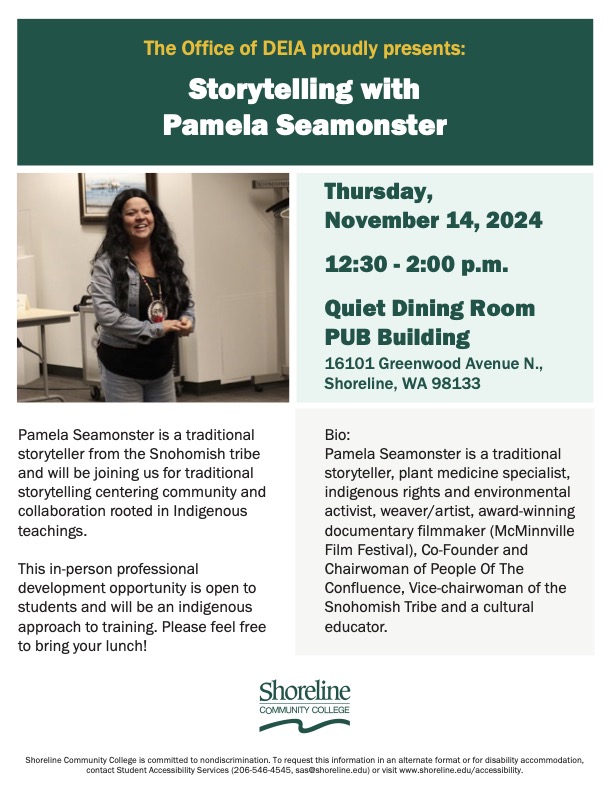
Nov 14th at 12:30 pm to 2:00 pm in Quiet Dining Room: Storytelling w/ Pamela Seamonster. Pamela Seamonster is a traditional storyteller from the Snohomish tribe and will be joining us for traditional storytelling centering community and collaboration rooted in Indigenous teachings. This professional development opportunity is open to students and will be an indigenous approach to training. Please feel free to bring your lunch! This event is only available in person.  

    This is a flyer with an image of the storyteller Pamela Seamonster on it advertising the event being held on 11/14 from 12:30-2:00pm.

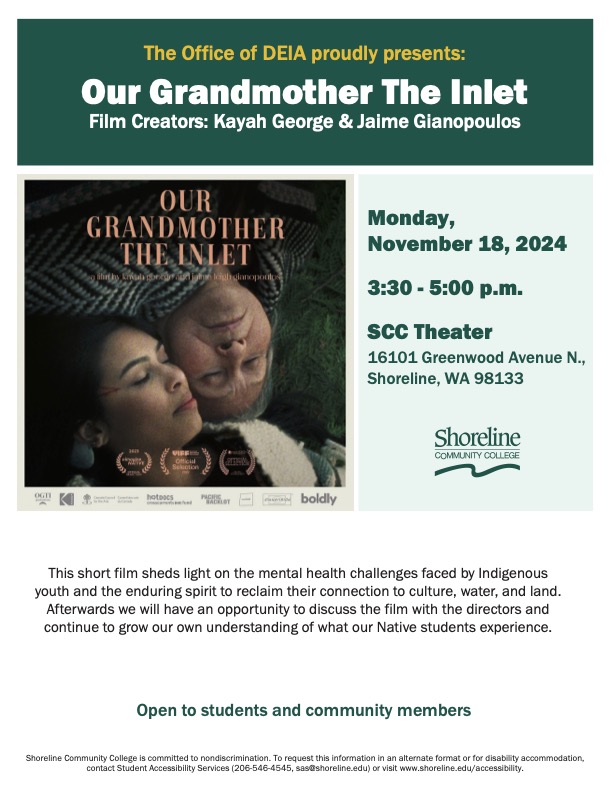
    Nov 18th @ 3:30 pm to 5:00 pm in the Theater:Our Grandmother The Inlet. This film was created by Kayah George & Jaime Gianopoulos in partnership with “Sacred Trust” which is led by The Tslesil-Waututh Nation. This short film sheds light on the mental health challenges faced by Indigenous youth and the enduring spirit to reclaim their connection to culture, water, and land. Afterwards we will have an opportunity to discuss the film with the directors and continue to grow our own understanding of what our Native students experience.  

      This is an image of two indigenous women, one younger and one older lying on their backs head to head.  It is advertising the event on Monday 11/18.

      Both opportunities are open to both students & community members and will serve as a great way for our teams to learn about Native communities and issues that are close to Native communities & our Native students.  Due to requests from our facilitators these opportunities are in person only to respect the cultural practices.

      Best,

      Brian Crisanto Ramos M.A. (He/Him) Vice President of Diversity, Equity, Inclusion, and Accessibility.   Pipil, Lenca, & Mayan Nations

      For Awareness: Student Post-Election Check-in: Healing Through Community 11/14/24

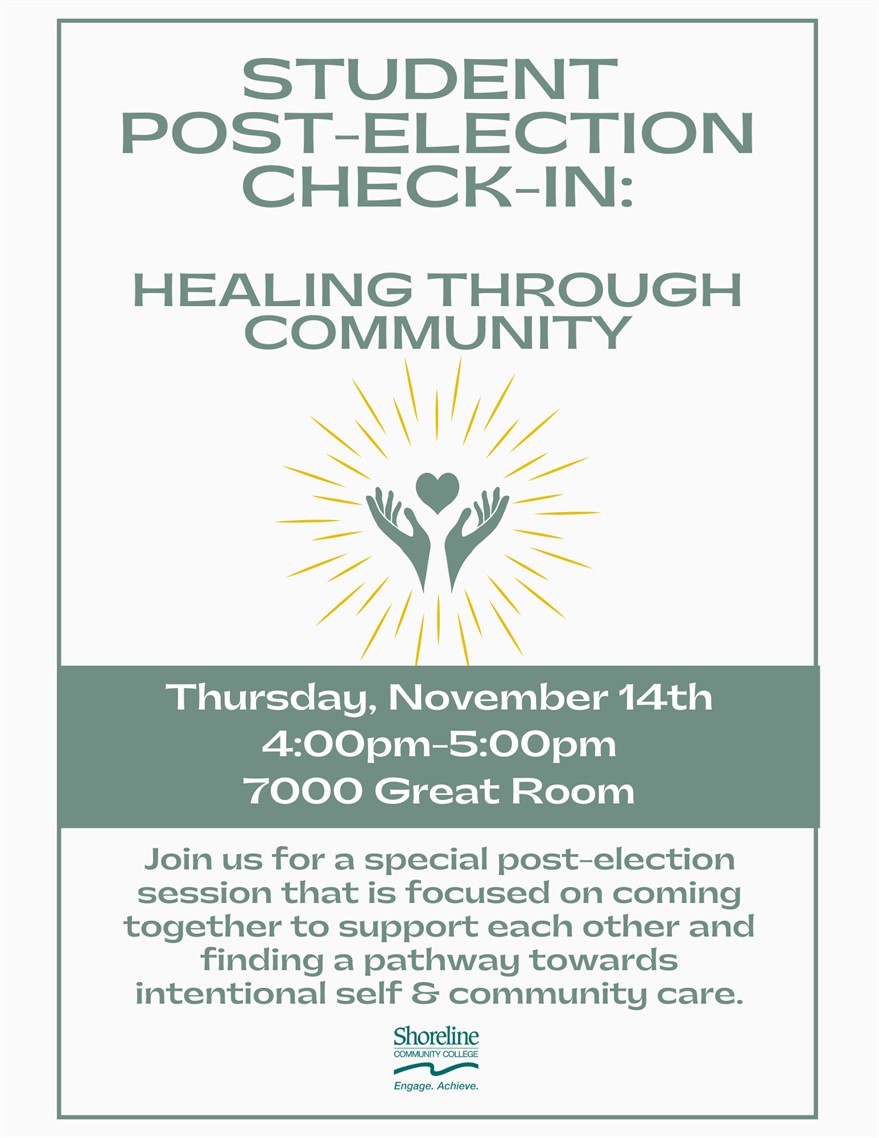
      Election season can be a difficult time for everyone and as things settle, we want to take a moment for students to come together and reflect on how we are doing and share how we are taking care of ourselves during this time.

      • Date: Thursday 11/14/24
      • Time: 4:00-5:00pm
      • Location: 7000 Building, Great Room
      This is a flyer that is white and sage green advertising this event.

      Did You Know? Food Allergies are Disabilities: The Latest from the Accessibility Advisory Committee

      Did You Know? Food Allergies are Disabilities:

      The Latest from the Accessibility Advisory Committee

      Allergies as a Disabilities

      Food allergies, asthma, and other allergies are covered by the Americans with Disabilities Act Amendments Act of 2008 (ADAAA). Why? The definition of “disability” as something that “significantly limits a major life activity.” This would include things such as eating, breathing, and working. As such, a person who cannot eat certain foods, has trouble breathing due to them, and potentially is allergic to something in their workplace is considered a person with a disability. A person does not have to be consistently allergic to something to be considered “disabled;” if they only have symptoms when triggered by the thing that they are allergic to, meaning it is an “episodic disability,” they would still be considered disabled. The Washington Law Against Discrimination (WLAD) has a similar definition and also covers people with allergies.

      Are Employees with Food Allergies Entitled to Reasonable Accommodations?

      Like all workplace accommodations, food allergy accommodations are determined as reasonable on a case-by-case basis, dependent on a few factors. Each person’s situation is individual, their barriers are unique. Also, they must still be able to perform the essential functions of their job with reasonable accommodations. That said, employees who are triggered by allergies in their workplace can always ask for accommodations and their employer is required to go through the Interactive Process and attempt to accommodate them.

      Did You Know?

      • Some people can have allergic reactions just by touching a surface that was touched by another person who ate something they are allergic to.
      • Some people can react to allergens in the air around them, including dust from food.
      • Not all people with allergies use EpiPens; this does not mean that they do not have a serious allergy.
      • How Can We Be More Allergy-Conscious?
      • There are several ways to try to be conscious of potential allergies, particularly when providing food, whether in the workplace, when organizing events, or when partying with friends and family. See below for some ideas:
      • Don’t serve nuts or peanuts (or other common allergens) at events you are hosting. If it can’t be avoided: use an entirely separate area with separate utensils, etc. OR if it can’t be avoided, keep them entirely separate (separate table, separate knives used to cut things, etc.).
      • Don’t serve foods where the ingredients are unknown and label the dishes you are serving.
      • Notify attendees of your event if common allergens (such as nuts, dairy, soy, and eggs) will be present at an event.
      • Educate your team about food allergies in the workplace (cross contamination, keeping common allergens out of potluck events, etc.).
      • Offer remote options for all campus events when allergens can’t be avoided.​

      Resources

      This is an ecru colored background with a teal ribbon advertising food allergy awareness.

      How are we doing?

      Please submit feedback about the information that the Accessibility Advisory Committee shares to Miranda Levy via email at mlevy@shoreline.edu so that the committee can review together and serve the campus community better.

      Build a D&D Character to Explore Identity- 11/21/24

      This interactive activity will focus on character creation with an eye toward self-representation and exploring different identities. While gamers create a character sheet for an RPG experience, they will explore the ways in which a fictional setting allows us to explore our own identities and to better understand the experiences of others.

      • Date: Thursday 11/21/24
      • Time: 6:00-7:00pm
      • Location: Library, Rm 4202

      Scan the QR code below to access a character sheet

      QR codes that leads to a character worksheet