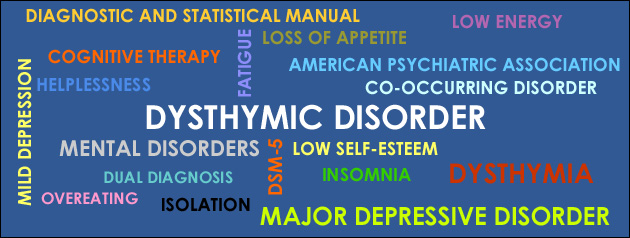
Disability Awareness Month Tip for Oct. 23: Facts About Dysthymia

dysthmia
In honor of Disability Employment Awareness Month, the Office of Special Services (OSS) is working to raise awareness of disabilities by offering daily facts and tips about people with disabilities and living with disability. Please take a minute to read and broaden your understanding.

Facts about Dysthymia
Dysthymia (dis-THIE-me-uh) is a mild but long-term (chronic) form of depression. Symptoms usually last for at least two years, and often for much longer than that. Dysthymia interferes with your ability to function and enjoy life.

With dysthymia, you may lose interest in normal daily activities, feel hopeless, lack productivity, and have low self-esteem and an overall feeling of inadequacy. People with dysthymia are often thought of as being overly critical, constantly complaining and incapable of having fun.

Dysthymia symptoms in adults may include:

  • Loss of interest in daily activities
  • Sadness or feeling down
  • Hopelessness
  • Tiredness and lack of energy
  • Low self-esteem, self-criticism or feeling incapable
  • Trouble concentrating and trouble making decisions
  • Irritability or excessive anger
  • Decreased activity, effectiveness and productivity
  • Avoidance of social activities
  • Feelings of guilt and worries over the past
  • Poor appetite or overeating
  • Sleep problems

In children, dysthymia sometimes occurs along with attention-deficit/hyperactivity disorder (ADHD), behavioral or learning disorders, anxiety disorders, or developmental disabilities. Examples of dysthymia symptoms in children include:

  • Irritability
  • Behavior problems
  • Poor school performance
  • Pessimistic attitude
  • Poor social skills
  • Low self-esteem

Dysthymia symptoms usually come and go over a period of years, and their intensity can change over time. But typically symptoms don’t disappear for more than two months at a time. In general, you may find it hard to be upbeat even on happy occasions — you may be described as having a gloomy personality.

When dysthymia starts before age 21, it’s called early-onset dysthymia. When it starts after that, it’s called late-onset dysthymia.

When to see a doctor
It’s perfectly normal to feel sad or upset sometimes or to be unhappy with stressful situations in your life. But with dysthymia, these feelings last for years and interfere with your relationships, work and daily activities.

Because these feelings have gone on for such a long time, you may think they’ll always be part of your life. But if you have any symptoms of dysthymia, seek medical help. If not effectively treated, dysthymia commonly progresses into major depression. Sometimes, a major depression episode occurs in addition to dysthymia — this is called double depression.

Talk to your primary care doctor about your symptoms. Or seek help directly from a mental health provider. If you’re reluctant to see a mental health professional, reach out to someone else who may be able to help guide you to treatment, whether it’s a friend or loved one, a teacher, a faith leader, or someone else you trust.

The above information and more can be found here and here.

The Office of Special Services Presents the Film FIXED, Mon. Oct. 26

fixed
In honor of Disability Employment Awareness Month, the Office of Special Services (OSS) is working to raise awareness of disabilities by offering a movie screening of FIXED.

FIXED Mon., Oct. 26 from 1-3 p.m. (movie is 60 minutes, with a discussion afterwards for those who can stay) in room 1504.

What is FIXED about??

A haunting, subtle, urgent documentary, FIXED questions commonly held beliefs about disability and normalcy by exploring technologies that promise to change our bodies and mind forever. Told primarily through the perspectives of five people with disabilities: a scientist, journalist, disability justice educator, bionics engineer and exoskeleton test pilot, FIXED takes a close look at the implications of emerging human enhancement technologies for the future of humanity.

Check out the trailer here.

Please contact the Office of Special Services if you have questions or would like to schedule a discussion of the topic or a showing of the movie in your class.

Kathy Cook, Associate Dean
Office of Special Services
Ext. 4544

National Disability Awareness Month Tip for Oct. 22: Facts About Stuttering

In honor of Disability Employment Awareness Month, the Office of Special Services (OSS) is working to raise awareness of disabilities by offering daily facts and tips about people with disabilities and living with disability. Please take a minute to read and broaden your understanding.

International Stuttering Awareness Day – October 22
Did You Know?

  • Stuttering is a communication disorder involving disruptions, or dysfluencies, in a person’s speech, but there are nearly as many ways to stutter as there are people who stutter.
  • The National Stuttering Association is a non-profit organization – the largest in the world – started in 1977, dedicated to bringing hope and empowerment to children and adults who stutter, their families, and professionals through support, education, advocacy, and research. Our organization is largely volunteer run and member-donation funded.

Common Myths about Stuttering
People have found stuttering confusing for centuries, and as with so many mysteries, they have tried to explain it with folklore. For instance, people in some cultures once believed that a child stuttered because his mother saw a snake during pregnancy or because he ate a grasshopper as a toddler. We now know that stuttering is probably neurological in origin, may have genetic origins, and often results in emotional components.

However, myths about stuttering persist today. Here are just a few of them:

  • People stutter because they are nervous. Because fluent speakers occasionally become more disfluent when they are nervous or under stress, some people assume that people who stutter do so for the same reason. While people who stutter may be nervous because they stutter, nervousness is not the cause.
  • People who stutter are shy and self-conscious. Children and adults who stutter often are hesitant to speak up, but they are not otherwise shy by nature. Once they come to terms with stuttering, people who stutter can be assertive and outspoken. Many have succeeded in leadership positions that require talking.
  • Stuttering is a psychological disorder. Emotional factors often accompany stuttering but it is not primarily a psychological condition. Stuttering treatment often includes counseling to help people who stutter deal with attitudes and fears that may be the result of stuttering.
  • People who stutter are less intelligent or capable. People who stutter are disproving this every day. The stuttering community has its share of scientists, writers, and college professors. People who stutter have achieved success in every profession imaginable.
  • Stuttering is caused by emotional trauma. Some have suggested that a traumatic episode may trigger stuttering in a child who already is predisposed to it, but the general scientific consensus is that this is not usually the root cause of the disorder.
  • Stuttering is caused by bad parenting. When a child stutters, it is not the parents’ fault. Stress in a child’s environment child can exacerbate stuttering, but is not the cause.
  • Stuttering is just a habit that people can break if they want to. Although the manner in which people stutter may develop in certain patterns, the cause of stuttering itself is not due to a habit. Because stuttering is a neurological condition, many, if not most, people who stutter as older children or adults will continue to do so—in some fashion—even when they work very hard at changing their speech.
  • Children who stutter are imitating a stuttering parent or relative. Stuttering is not contagious. Since stuttering often runs in families, however, children who have a parent or close relative who stutters may be at risk for stuttering themselves. This is due to shared genes, not imitation.
  • Forcing a left-handed child to become right-handed causes stuttering. This was widely believed early in the 20th century but has been disproven in most studies since 1940. Although attempts to change handedness do not cause stuttering, the stress that resulted when a child was forced to switch hands may have exacerbated stuttering for some individuals.
  • Identifying or labeling a child as a stutterer results in chronic stuttering. This was the premise of a famous study in 1939. The study was discredited decades ago, but this outdated theory still crops up occasionally. Today, we know that talking about stuttering does not cause a child to stutter.

These are just a few of the common myths out there. Instead of perpetuating such myths, it is important to have the Facts About Stuttering!

The above information and more can be found here and here.

Disability Awareness Month Tip for Oct. 21: Facts About Polio

In honor of National Disability Employment Awareness Month, the Office of Special Services (OSS) is working to raise awareness of disabilities by offering daily facts and tips about people with disabilities and living with disability. Please take a minute to read and broaden your understanding.

October is Polio Awareness Month

Poliomyelitis (polio) is a highly infectious viral disease, which mainly affects young children. The virus is transmitted person-to-person spread mainly through the faecal-oral route or, less frequently, by a common vehicle (e.g., contaminated water or food) and multiplies in the intestine, from where it can invade the nervous system and can cause paralysis.

Initial symptoms of polio include fever, fatigue, headache, vomiting, stiffness in the neck and pain in the limbs. In a small proportion of cases, the disease causes paralysis, which is often permanent. There is no cure for polio, it can only be prevented by immunization.

Key facts

  • Polio (poliomyelitis) mainly affects children under 5 years of age.
  • One in 200 infections leads to irreversible paralysis. Among those paralysed, 5% to 10% die when their breathing muscles become immobilized.
  • Polio cases have decreased by over 99% since 1988, from an estimated 350,000 cases then, to 359 reported cases in 2014. The reduction is the result of the global effort to eradicate the disease.
  • Today, only 2 countries (Afghanistan and Pakistan) remain polio-endemic, down from more than 125 in 1988.
  • As long as a single child remains infected, children in all countries are at risk of contracting polio. Failure to eradicate polio from these last remaining strongholds could result in as many as 200,000 new cases every year, within 10 years, all over the world.
  • In most countries, the global effort has expanded capacities to tackle other infectious diseases by building effective surveillance and immunization systems.

Polio and its symptoms
Polio is a highly infectious disease caused by a virus. It invades the nervous system, and can cause total paralysis in a matter of hours. One in 200 infections leads to irreversible paralysis (usually in the legs). Among those paralysed, 5% to 10% die when their breathing muscles become immobilized.

Global caseload
Today, only 2 countries in the world remain endemic for the disease–the smallest geographic area in history. Of the 3 strains of wild poliovirus (type 1, type 2, and type 3), wild poliovirus type 2 was eradicated in 1999 and case numbers of wild poliovirus type 3 are down to the lowest-ever levels with the no cases reported since November 2012 from Nigeria.

The above information and more can be found here.

Disability Employment Awareness Month Tip for Oct. 20: Facts About Eczema

eczema
In honor of Disability Employment Awareness Month, the Office of Special Services (OSS) is working to raise awareness of disabilities by offering daily facts and tips about people with disabilities and living with disability. Please take a minute to read and broaden your understanding.

Facts About Eczema

What is eczema?
Eczema (atopic dermatitis) is a recurring, non-infectious, inflammatory skin condition affecting one in three Australasians at some stage throughout their lives. The condition is most common in people with a family history of an atopic disorder, including asthma or hay fever.

Atopic eczema is the most common form of the disease among Australasians. The skin becomes red, dry, itchy and scaly, and in severe cases, may weep, bleed and crust over, causing the sufferer much discomfort. Sometimes the skin may become infected. The condition can also flare and subside for no apparent reason.

Although eczema affects all ages, it usually appears in early childhood (in babies between two-to-six months of age) and disappears around six years of age. In fact, more than half of all eczema sufferers show signs within their first 12 months of life and 20 per cent of people develop eczema before the age of five.

Most children grow out of the condition, but a small percentage may experience severe eczema into adulthood. The condition can not only affect the individual sufferer, but also their family and friends. Adult onset eczema is often very difficult to treat and may be caused by other factors such as medications.

What causes eczema?
The exact cause of eczema is unknown – it appears to be linked to the following internal and external triggers:

Internal

  • A family history of eczema, asthma or hay fever (the strongest predictor): if both parents have eczema, there is an 80 percent chance that their children may also develop eczema
  • Some foods and alcohol: dairy and wheat products, citrus fruits, eggs, nuts, seafood, chemical food additives, preservatives and colorings
  • Stress

External

  • Irritants: tobacco smoke, chemicals, weather (hot and humid or cold and dry conditions) and air conditioning or overheating
  • Allergens : house dust mites, molds, grasses, plant pollens, foods, pets and clothing, soaps, shampoos and washing

What are the symptoms of eczema?

  • Moderate-to-severely itching skin
  • rash – dry, red, patchy or cracked skin. Commonly it appears on the face, hands, neck, inner elbows, backs of the knees and ankles, but can appear on any part of the body.
  • Skin weeping watery fluid
  • Rough, “leathery,” thick skin

How does eczema affect people?
Although eczema in itself is not a life-threatening disease, it can certainly have a debilitating effect on a sufferer, their careers and their family’s quality of life. Night-time itching can cause sleepless nights and place a significant strain upon relationships. Eczema ‘flare-ups’ can often lead to absenteeism from work, school, personal activities & responsibilities. For some severe sufferers it can also mean hospitalizations & costly treatments.

Is there a cure for eczema?
Although there is no known cure for eczema and it can be a lifelong condition, treatment can offer symptom control.

How do you diagnose eczema?
Only a doctor or skin specialist, usually a Dermatologist, can formally diagnose eczema. An accurate diagnosis requires a complete skin examination, a thorough medical history and the presence of a chronically recurring rash with intense itching that is consistent with eczema. Itching is an important clue to diagnosing eczema. If an itch is not present, chances are that the problem is not eczema.

While there is no test to determine whether a person has eczema, tests may be conducted to rule out other possibilities. The above information and more can be found at www.exzema.org.au.