Disability Awareness Month Tip for Mon., Oct. 12: Understanding Dyspraxia

dyspraxia
In honor of Disability Employment Awareness Month, the Office of Special Services (OSS) is working to raise awareness of disabilities by offering daily facts and tips about people with disabilities and living with disability. Please take a minute to read and broaden your understanding.

Oct. 11-17 is Dyspraxia Awareness Week

What is dyspraxia?

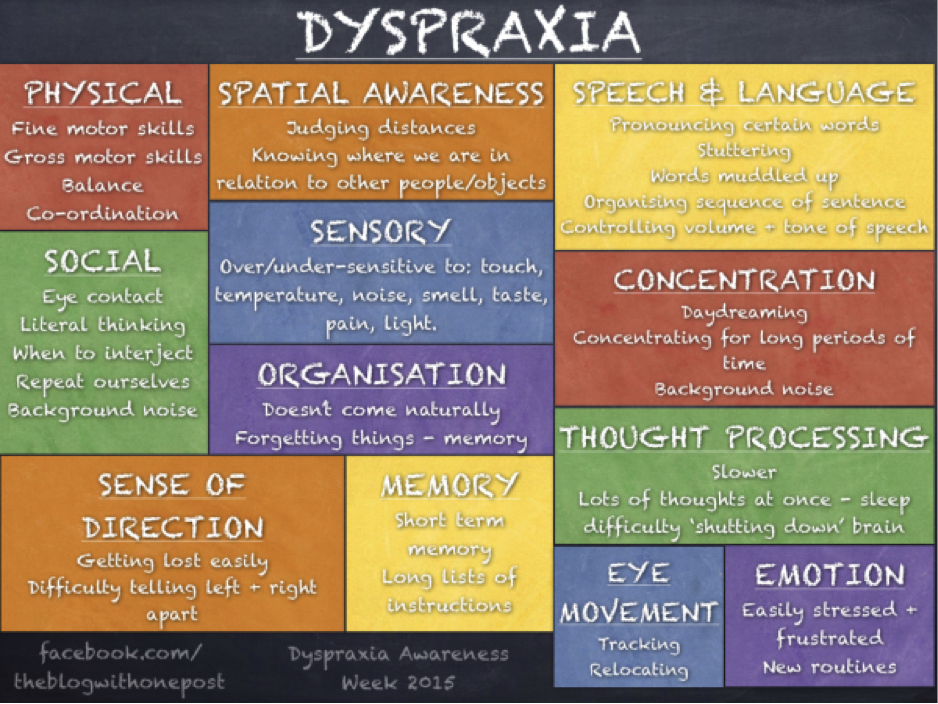
Dyspraxia isn’t a sign of muscle weakness or of low intelligence. It’s a brain-based condition that makes it hard to plan and coordinate physical movement. Children with dyspraxia tend to struggle with balance and posture. They may appear clumsy or “out of sync” with their environment.[1]

Dyspraxia goes by many names: developmental coordination disorder, motor learning difficulty, motor planning difficulty and apraxia of speech. It can affect the development of gross motor skills like walking or jumping. It can also affect fine motor skills. These include things like the hand movements needed to write clearly and the mouth and tongue movements needed to pronounce words correctly.

Dyspraxia can affect social skills too. Children with dyspraxia may behave immaturely even though they typically have average or above-average intelligence.

Kids don’t outgrow dyspraxia. But occupational therapy, physical therapy, speech therapy and other tools and strategies can help. Kids can learn to work around areas of weakness and build on their strengths.

Different Kinds of Dyspraxia
Dyspraxia can affect different kinds of movement. Professionals you speak to might break it down into these categories:

  • Ideomotor dyspraxia: Makes it hard to complete single-step motor tasks such as combing hair and waving goodbye.
  • Ideational dyspraxia: Makes it more difficult to perform a sequence of movements, like brushing teeth or making a bed.
  • Oromotor dyspraxia, also called verbal apraxia or apraxia of speech: Makes it difficult to coordinate muscle movements needed to pronounce words. Kids with dyspraxia may have speech that is slurred and difficult to understand because they’re unable to enunciate.
  • Constructional dyspraxia: Makes it harder to understand spatial relationships. Kids with this type of dyspraxia may have difficulty copying geometric drawings or using building blocks.[2]

The above information was taken from and can be found on Understood.org.

Disability Awareness Month Tip for Thurs., Oct. 8: World Sight Day

Screen Shot 2015-10-07 at 3.41.26 PM
In honor of Disability Employment Awareness Month, the Office of Special Services (OSS) is working to raise awareness of disabilities by offering daily facts and tips about people with disabilities and living with disability. Please take a minute to read and broaden your understanding.

Today’s topic is: October 8, 2015 is World Sight Day. This year’s call to action:

World Sight Day is an important advocacy and communications opportunity for the eye health community. It is a great time to engage with a wider audience – a patient’s family, those who seldom get an eye exam, diabetics – and showcase why eye health needs everybody’s attention.

Eye care for all: This year, The International Agency for the Prevention of Blindness (IAPB) urges you to focus on everybody who needs eye care services – everybody. Think of all the groups of people who need eye care – especially the most vulnerable or the ones most in need. What can we do to bring eye care to them all? How can we ensure that access to eye care is not limited by gender or geographic location, or even financial status? Do remember, ‘Eye Health’ also includes rehabilitation and assistive services for those with irreversible vision loss.

This World Sight Day, let’s do something that will draw attention to the great unmet need in eye care services.

On World Sight Day, IAPB members work together to:

1. Raise public awareness of blindness & vision impairment as major international public health issues
2. Influence Governments/Ministers of Health to participate in and designate funds for national blindness prevention programs
3. Educate target audiences about blindness prevention,  about VISION 2020 and to generate support for VISION 2020 program activities

International Key Messages:

1. Approximately 285 million people worldwide live with low vision and blindness
2. Of these, 39 million people are blind and 246 million have moderate or severe visual impairment
3. 90% of blind people live in low-income countries
4. Yet 80% of visual impairment is avoidable – i.e. readily treatable and/or preventable
5. Restorations of sight, and blindness prevention strategies are among the most cost-effective interventions in health care
6. The number of people blind from infectious causes has greatly reduced in the past 20 years
7. An estimated 19 million children are visually impaired
8. About 65 % of all people who are visually impaired are aged 50 and older, while this age group comprises only 20% of the world’s population
9. Increasing elderly populations in many countries mean that more people will be at risk of age-related visual impairment.

The above information was taken from the website of the IAPB. For more information about World Sight Day, click here.

Shoreline’s Disability Awareness Society Honors International Cerebral Palsy Day Wed., Oct. 7

wcpday
October 7, 2015 is World Cerebral Palsy Day. In honor of this day, the students in Shoreline’s Disability Awareness Society will be hosting a table in the PUB from 11:30 a.m. – 1:30 p.m. to help educate the campus community on cerebral palsy…a disability that affects 17 million people world-wide.

Although cerebral palsy (CP) is the most common physical disability in childhood, it is widely misunderstood. Through World CP Day, we have the opportunity to raise awareness of CP in our communities and assist others to look beyond the disability.

Public awareness is an issue because CP is a complex, lifelong disability. It primarily affects movement, but people with CP may also have visual, learning, hearing, speech, epilepsy and intellectual impairments. It can be mild, such as a weakness in one hand, to severe cases in which people have little control over movements or speech and may need 24-hour assistance.

People living with CP can experience a range of responses from others in their communities. On one end of the spectrum, they can face deep-seated but misguided sympathy, or even pity. Though intentions are good, they infantilize the person with CP. They can be smothered with (too much) love, and spoken to in a simple, childlike way. Others can subconsciously over-protect a person with CP, and thus prevent them from having essential life experiences.

On the other end of the spectrum, CP is viewed through deep-seated cultural beliefs. It may be seen as validation of superstitions about the mother, or wrath upon a family. Some even believe that CP is contagious or that a child with CP brings shame to a family. Mothers may be abandoned with their child, or a person with CP may live their life in an institution.

And in the middle are thousands of fine people who still find it difficult to make eye contact or know how to communicate with someone who has CP. It is not that they feel any ill will, it is just best—maybe even polite—to not engage.

There is nothing to be gained in blaming people for their ignorance about CP. Instead, we will work to put an end to it. We have the ability and the moral obligation to ensure everyone knows the real truth, and acts accordingly.

The above information and more can be found on the World CP Day’s site. For an graphic with even more information about cerebral palsy, click here.

Disability Awareness Month Tip for Tues., Oct. 6

In honor of Disability Employment Awareness Month, the Office of Special Services (OSS) is working to raise awareness of disabilities by offering daily facts and tips about people with disabilities and living with disability. Please take a minute to read each day’s fact and broaden your understanding.

Today’s topic is: Facts About Deafness

Here is some general information to know about the Deaf:

  • There are approximately 22-28 million Deaf and Hard of Hearing people in the United States.
  • Deaf people, for the most part, prefer to be called “deaf.”
  • Hard of Hearing individuals have significant hearing loss, but they still have enough residual hearing to be able, with or without amplification, to understand a large majority of human speech.
  • Even the most experienced and skilled lip readers can only understand about 30% of English speech. Most words are ambiguous and unidentifiable on the lips. Also, many different sounds look the same on the lips.
  • Sign language is not universal. American Sign Language is the language used by most Deaf individuals living in the United States and a large part of Canada. There are almost as many sign languages as there are spoken languages in the world.
  • 90% of Deaf children are born to Hearing parents.
  • The Deaf work in fields such as architecture, clergy, corporations, education, entertainment, financial institutions, government, law and law enforcement, medicine, science, and technology.
  • Not all Deaf individuals use sign language as their primary mode of communication. If a deaf person is educated in an oral environment they live their lives and function in the “hearing world” without the use of sign language. Late deafened adults often choose to continue communicating oral-aurally and lip/speech read, using what residual hearing they have left.

The above information and more can be found at Beyond the Words, Inc.

The OSS on campus serves students with disabilities and also promotes disability awareness through the provision of disability related information. Please contact OSS directly if you have questions (oss@shoreline.edu, (206) 546-4545, FOSS building, 5226).

October is National Disability Employment Awareness Month

disability
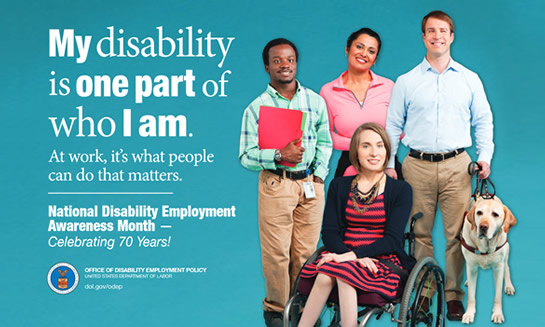
This month gives us an opportunity to celebrate the many and varied contributions of America’s workers with disabilities. The theme for this year — which marks 70 years since the first observance — is “My Disability is One Part of Who I Am.”

Shoreline Community College — through a collaboration between the Office of Special Services, the Disability Awareness Society and the Associated Students of Shoreline — will be celebrating Disability Employment Awareness month and will be providing disability related tips and information each day to help raise awareness and encourage people to see beyond a person’s disability and see the person, not just their disability.

As part of our effort to raise awareness, we’re holding a weekly contest. Every Monday in October (starting Mon., Oct. 5), we’ll distribute a quote written in braille and American Sign Language. Contestants have until the following Friday afternoon to submit an entry form with that quote translated into written English. Anyone submitting an entry form will be entered into a drawing to win a $10 gift card to the bookstore. Drawings for the prize will be held Fridays at 3 p.m.

New quotes, entry forms and cheat sheets! (copies of the braille alphabet and the American Sign Language alphabet) are provided and will be available for pick up at the Bookstore, Office of Special Services (OSS) in FOSS 5226 and at the Community Integration and Employment Program office in room 2910.

Stay tuned for more information!!!!!