Advancement

Shoreline Community College Receives $697,300 Grant to Launch Veteran Success Through Education Program 

Shoreline Community College has been awarded a $697,300 grant through the Supporting Student Veterans and Their Families initiative, funded by the King County Veterans, Seniors and Human Services Levy. In partnership with the nonprofit Operation Military Family, Shoreline will launch the Veteran Success Through Education program, a two-year pilot effort to provide holistic support for veterans and their families, particularly those from marginalized communities. 

The grant, which spans from July 1, 2025, through June 30, 2027, will support culturally responsive case management, academic and financial assistance, and comprehensive wraparound services for eligible students. 

“This is an opportunity to serve veterans who may be navigating the complexities of higher education without access to, or who have exceeded traditional VA benefits,” said Derek Levy, Dean of Student Support & Success at Shoreline. “We’re excited to expand the services and supports we can offer to our veteran student community, both current and prospective, providing access and wraparound support in collaboration with Operation Military Family through the support of the King County Veterans, Seniors and Human Services Levy.” 

The Veteran Success Through Education program will focus on serving veterans from underrepresented communities, including BIPOC, LGBTQ+ individuals, formerly incarcerated veterans, and those who have exhausted or are not eligible for VA benefits. Operation Military Family will provide individualized case management, both remotely and on campus, and help connect Shoreline with veterans in need through an established network across the region. 

Funding from the grant will enable Shoreline to assist with tuition, incidental expenses, and housing assistance for eligible students based on need. Participants will also have full access to Shoreline’s robust student support services, including dedicated Veterans services and academic advising. 

“Through the Veteran Success Through Education program, we are honored to support those who have served our country, especially veterans from historically underserved communities, by providing the resources, guidance, and community they need to thrive in their academic and personal journeys,” said Ryan Aiello, Shoreline’s Vice President of Student Affairs. 

The grant builds on Shoreline’s growing efforts to provide inclusive, equitable access to education and serves as a bridge for those who may be seeking a new path after military service. 

Joshua Salois, Program Specialist II who works primarily with Shoreline’s Veterans population, had this to say about the grant.  “I’m excited for us to have the opportunity to support even more student Veterans and family members; especially folks coming from marginalized and often vulnerable populations. Even something seemingly small, like getting a professional certificate, can be so empowering and transformative, so for our program to have more ability to give that chance to those who may not have otherwise had it is just really amazing.”  

As a pilot program, Veteran Success Through Education will run through June 2027 with the potential to inform and expand future support for veteran students across King County. 
Press Release: Shoreline Community College Secures $500K Grant to Enhance Equity in STEM Education 

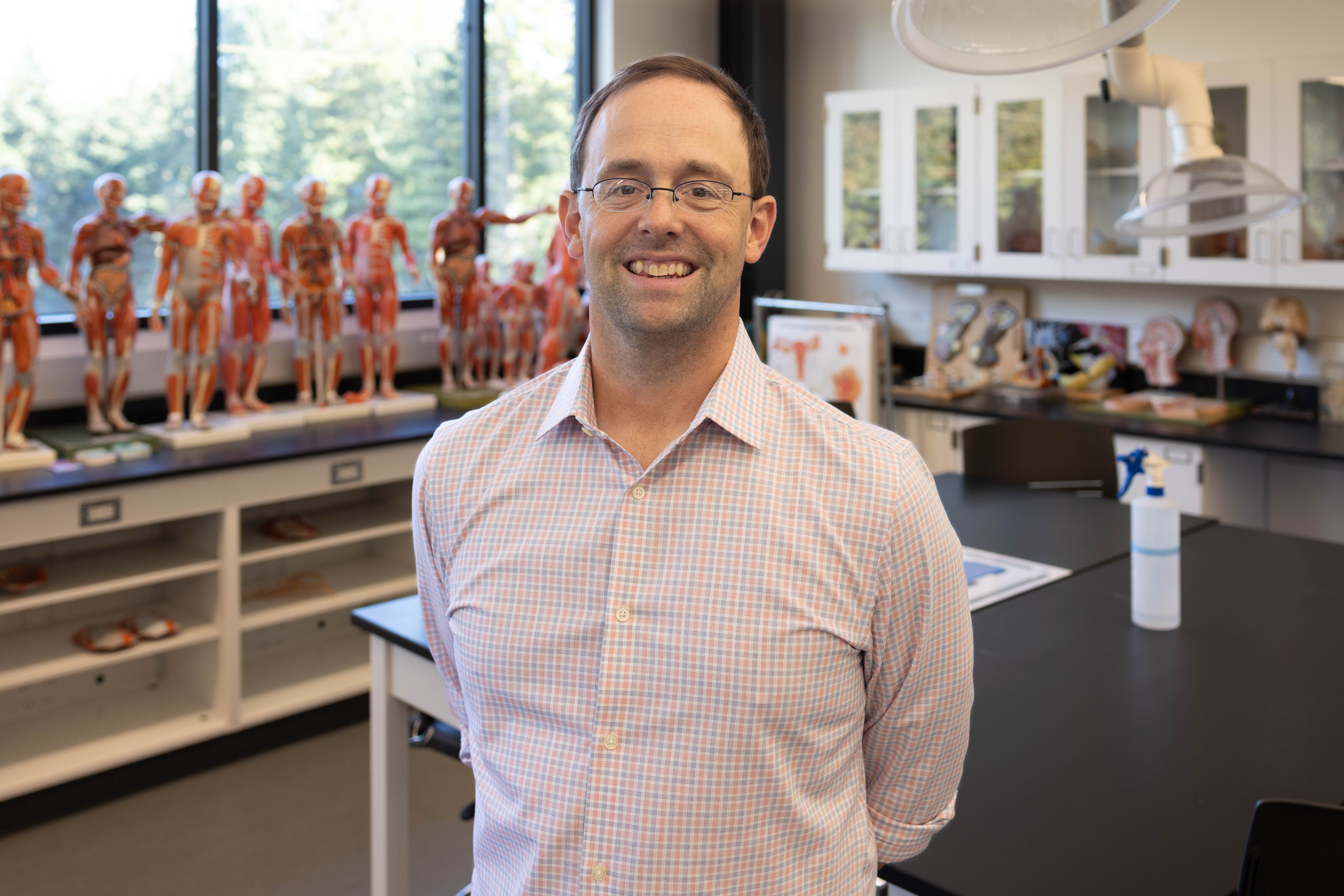
Dr. Ben Wiggins stands in Shoreline Community College's new science lab

Shoreline Community College (Shoreline) has been awarded a prestigious $500,000 grant from the National Science Foundation (NSF) as part of their inaugural Innovation in Two-Year College STEM Education (ITYC) program. This significant funding will support a groundbreaking project led by Professor Ben Wiggins, aimed at transforming how science exams are designed and administered in community college classrooms across the country. 

The Pre-Released Exam Strategy Assessment Research (PRExSAR) project is one of 27 selected for funding through the NSF’s ITYC program, which awarded a total of $14.5 million in grants in its first year. This initiative seeks to advance innovative, evidence-based practices that enhance STEM education at two-year colleges nationwide. 

Dr. Wiggins, a biology professor at Shoreline leads the project, which focuses on making science exams more equitable and effective for students. Partnering with professors from community colleges nationwide, the research team will explore how different exam strategies impact student performance and engagement. This innovative approach allows students to see the exam format and key concepts beforehand, fostering deeper learning and reducing test anxiety. 

“For years, I’ve seen students struggle with traditional science exams, which can feel like a barrier to their success,” Wiggins explains. “This project allows us to explore how small changes to exam design can make a big difference, without adding extra burden on professors. We want to empower instructors with better tools, so they can help students thrive.” 

In collaboration with Professor Greg Crowther of Everett Community College, the project will interview students and faculty from around the country, conduct experiments, and publish research that identifies the most effective and sustainable exam methods. “Five years ago, I stumbled across a blog post in which Ben outlined his Public Exam system. I was simultaneously impressed with Ben’s ideas and inspired to adapt them to my own classroom concerns and context, which led to the Test Question Template (TQT) framework. I’m delighted that our partnership and our work has now progressed to the point of attracting significant support from the NSF,” said Crowther about the project. 

Findings from the study will provide essential insights into how to create assessments that foster greater student success, particularly in STEM fields. 

“The need for a robust STEM workforce has never been greater,” Wiggins notes. “But outdated teaching methods and brutal exams are driving students away, often reinforcing the patterns of who has historically been allowed to succeed in science. This grant gives us a chance to change that narrative and bring real solutions to the table.” 

The NSF’s ITYC program is part of a larger effort to expand STEM opportunities for community college students, a crucial demographic for the nation’s future scientists, engineers, and technicians. The program seeks to address the unique challenges faced by two-year institutions and ensure that students from diverse backgrounds have equitable access to STEM education. 

Shoreline’s Vice President of Instruction, Dr Ben Weng emphasizes the importance of this reach: “Professor Wiggins’ project pioneers equitable assessment methods to elevate STEM teaching and learning. This innovative approach seeks to engage our diverse student body, particularly the traditionally underrepresented groups in STEM. The initiative aligns with Shoreline’s institutional goals for inclusive excellence in education. We wish him great success! 

As Shoreline Community College leads this innovative research, the PRExSAR project has the potential to create lasting changes in how exams are designed and administered across the country, helping students succeed in their STEM education and beyond. 

Title III Grants Update- Fall 2023

Title III Grants update – Fall 2023

Hello from the Shoreline Title III Grants team!  We’re working hard this year to improve communication & transparency.  We’ll be publishing periodic video updates throughout the year, and we have created a new Title III SharePoint site where you can find project plans and important information.  We are sending a Fall Title III Update now, albeit a bit late.  You can read the update below, or watch a video update instead!  Please note that since the video was filed, the Guidance Services Redesign project has been renamed “Student Success Network Redesign.”

What is Title III?

Title III refers to a US Department of Education grant program that aims to help institutions of higher education increase their capacity to serve racially marginalized and financially under-resourced students.  Shoreline received two Title III grants in October 2021: the Strengthening Institutions Program (SIP) grant, and the Asian American Native American Pacific Islander Serving Institution (AANAPISI) grant.  

How do the grants relate to other collegewide initiatives?

Guided Pathways – The Title III grants were purposefully written to overlap with existing GP efforts, and GP projects we were hoping to get underway.  In many cases, we have one project satisfying the expectations of Guided Pathways and both Title III grants.  Many birds in one birdhouse!

Strategic Enrollment Management (SEM) – SEM focuses equally on both recruitment and retention.  Our Title III grants are retention-focused and inform or the retention strategies included in Shoreline’s SEM work.

Diversity, Equity, Inclusion & Accessibility (DEIA) – Both Title III grants are fundamentally racial equity initiatives whose stated goal is to narrow equity gaps in key student indicators.  All Title III projects are developed with special attention to improving outcomes for historically underserved student populations .

Accreditation – Shoreline’s accreditors have asked us to demonstrate improvements in the regular collection & use of data to inform planning & decision making.  Per federal requirements, we are regularly collecting lots of data to support our Title III grants, which will help us demonstrate progress toward our accreditation goals.

What are the projects?

Intake Redesign – An effort to streamline the set of activities students must complete between application & enrollment so that students understand what they need to do and receive proactive support when they need it. 

Student Success Network Redesign – An effort to rethink & integrate existing student support structures so that all students receive a common baseline of advising & advising-related support from their first quarter at Shoreline all the way through graduation.

Starfish Software – A student success technology that makes it easy for students to connect with the resources most useful to them. Facilitates a caseload management approach to student support.

College Success Course – A course for new students that focuses on career exploration, goal setting, educational planning, and resources & strategies for college success.

Peer Support Program – A team of Student Ambassadors who help new & continuing students navigate the college, and a separate team of First Year Peer Mentors who connect with new students through COL 101.

Expanded Peer Tutoring – An effort to increase Shoreline’s peer tutoring offerings for gateway Math & English courses and intentionally connect underserved students with tutoring resources they may not know about.

WAVES Program – A wraparound support program that offers culturally relevant services to Asian & Pacific Islander students, including advising, tutoring, a COL 101 cohort, a food pantry, a clothing drive, cultural events, community resources, and more.

Where can I learn more?

Visit the Title III SharePoint site for project overviews & updates.  You are always invited to email Moriah Shistle at mshistle@shoreline.edu with questions or suggestions.

Best regards,

Moriah Shistle, M.Ed

Director, SIP Grant

Pronouns: she/her/hers