
Disability Awareness Month Tip for Mon., Oct. 19: Emotional Intelligence

Young woman holding emotive masks

In honor of Disability Employment Awareness Month, the Office of Special Services (OSS) is working to raise awareness of disabilities by offering daily facts and tips about people with disabilities and living with disability. Please take a minute to read and broaden your understanding.

“All learning has an emotional base.” — Plato

The ability to express and control our emotions is essential, but so is our ability to understand, interpret, and respond to the emotions of others. Imagine a world where you could not understand when a friend was feeling sad or when a co-worker was angry. Psychologists refer to this ability as emotional intelligence, and some experts even suggest that it can be more important than IQ.

Learn more about exactly what emotional intelligence is, how it works, and how it is measured.

What is Emotional Intelligence?

Emotional intelligence (EI) refers to the ability to perceive, control and evaluate emotions. Some researchers suggest that emotional intelligence can be learned and strengthened, while others claim it is an inborn characteristic.

The Four Branches of Emotional Intelligence

Salovey and Mayer proposed a model that identified four different factors of emotional intelligence: the perception of emotion, the ability reason using emotions, the ability to understand emotion and the ability to manage emotions.

  1. Perceiving Emotions: The first step in understanding emotions is to perceive them accurately. In many cases, this might involve understanding nonverbal signals such as body language and facial expressions.
  2. Reasoning With Emotions: The next step involves using emotions to promote thinking and cognitive activity. Emotions help prioritize what we pay attention and react to; we respond emotionally to things that garner our attention.
  3. Understanding Emotions: The emotions that we perceive can carry a wide variety of meanings. If someone is expressing angry emotions, the observer must interpret the cause of their anger and what it might mean. For example, if your boss is acting angry, it might mean that he is dissatisfied with your work; or it could be because he got a speeding ticket on his way to work that morning or that he’s been fighting with his wife.
  4. Managing Emotions: The ability to manage emotions effectively is a crucial part of emotional intelligence. Regulating emotions, responding appropriately and responding to the emotions of others are all important aspect of emotional management.

According to Salovey and Mayer, the four branches of their model are, “arranged from more basic psychological processes to higher, more psychologically integrated processes. For example, the lowest level branch concerns the (relatively) simple abilities of perceiving and expressing emotion. In contrast, the highest level branch concerns the conscious, reflective regulation of emotion” (1997).

A Brief History of Emotional Intelligence

  • 1930s – Edward Thorndike describes the concept of “social intelligence” as the ability to get along with other people.
  • 1940s – David Wechsler suggests that affective components of intelligence may be essential to success in life.
  • 1950s – Humanistic psychologists such as Abraham Maslow describe how people can build emotional strength.
  • 1975 – Howard Gardner publishes The Shattered Mind, which introduces the concept of multiple intelligences.
  • 1985 – Wayne Payne introduces the term emotional intelligence in his doctoral dissertation entitled “A study of emotion: developing emotional intelligence; self-integration; relating to fear, pain and desire (theory, structure of reality, problem-solving, contraction/expansion, tuning in/coming out/letting go).”
  • 1987 – In an article published in Mensa Magazine, Keith Beasley uses the term “emotional quotient.” Some suggest that this is the first published use of the phrase, although Reuven Bar-On claims to have used the term in an unpublished version of his graduate thesis.
  • 1990 – Psychologists Peter Salovey and John Mayer publish their landmark article, “Emotional Intelligence,” in the journal Imagination, Cognition, and Personality.
  • 1995 – The concept of emotional intelligence is popularized after publication of psychologist and New York Times science writer Daniel Goleman’s book Emotional Intelligence: Why It Can Matter More Than IQ.

Measuring Emotional Intelligence

“In regard to measuring emotional intelligence – I am a great believer that criterion-report (that is, ability testing) is the only adequate method to employ. Intelligence is an ability, and is directly measured only by having people answer questions and evaluating the correctness of those answers.” –John D. Mayer

  • Reuven Bar-On’s EQ-i
    A self-report test designed to measure competencies including awareness, stress tolerance, problem-solving, and happiness. According to Bar-On, “Emotional intelligence is an array of noncognitive capabilities, competencies, and skills that influence one’s ability to succeed in coping with environmental demands and pressures.”
  • Multifactor Emotional Intelligence Scale (MEIS)
    An ability-based test in which test-takers perform tasks designed to assess their ability to perceive, identify, understand, and utilize emotions.
  • Seligman Attributional Style Questionnaire (SASQ)
    Originally designed as a screening test for the life insurance company Metropolitan Life, the SASQ measures optimism and pessimism.
  • Emotional Competence Inventory (ECI)
    Based on an older instrument known as the Self-Assessment Questionnaire, the ECI involves having people who know the individual offer ratings of that person’s abilities in several different emotional competencies.

The above information and more can be found here.
Disability Employment Awareness Month Tip for Oct. 16: Facts About Depression

depression
In honor of Disability Employment Awareness Month, the Office of Special Services (OSS) is working to raise awareness of disabilities by offering daily facts and tips about people with disabilities and living with disability. Please take a minute to read and broaden your understanding.

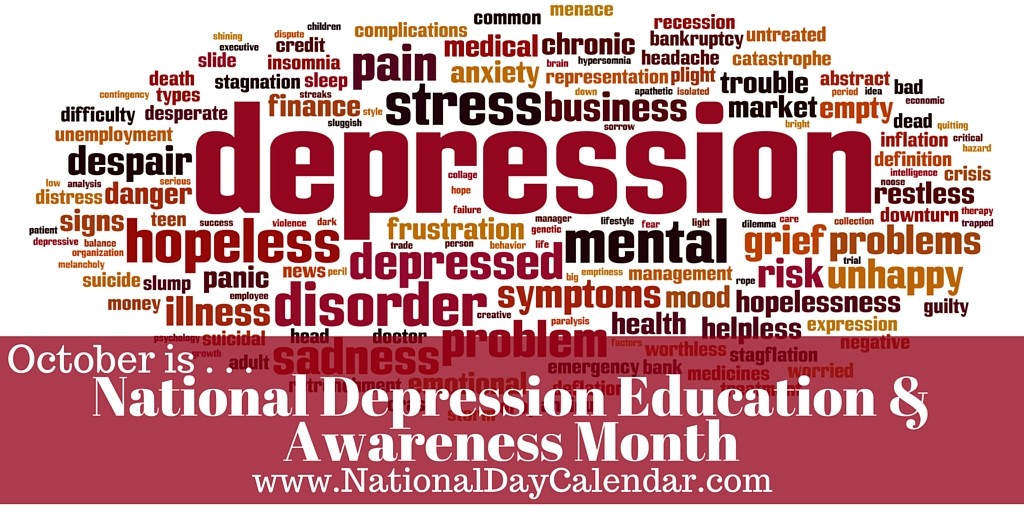
October is National Depression Education & Awareness Month!
October is National Depression Education and Awareness Month, and it’s the perfect time to shine a light on what has been called “the common cold” of mental illness. Depression affects more than 19 million Americans each year. This figure includes the following types of depression:

  • Major depressive disorder (also called major depression or clinical depression)
  • Manic depression (called bipolar disorder)
  • Dysthymia (a milder, but long-term type of depression)

How Does Depression Affect A Person?

Have you ever heard someone remark casually, “Oh, I’m so depressed….”? They may be referring to something other than depression. Depression is not the same as feeling sad or blue. It is not grief, although someone who is grieving may experience it while they mourn a loss.

Depression is a medical condition that has an impact on a person’s daily life. It interferes with someone’s ability to eat, sleep, work and even concentrate. Depression robs sufferers of their ability to engage in hobbies and activities that they previously enjoyed.

Signs And Symptoms Of Depression

Just about everyone has thought or felt one or more of the following signs and symptoms of depression from time to time. If several of the signs on this list seem familiar to you or about someone you love and are persistent, please seek help from a physician. If you are having thoughts about self-harm, go to your nearest Emergency Room immediately.

  • Feeling sad, anxious or “empty”
  • Irritability or restlessness
  • Hopelessness or pessimism
  • Feeling guilty or worthless
  • Lack of interest or pleasure in former hobbies or interests
  • Fatigue or lack of energy
  • Trouble concentrating, remembering or making decisions
  • Trouble getting to sleep or staying asleep
  • Lack of appetite or overeating
  • Headaches, digestive disorders or chronic pain that does not respond to treatment
  • Suicidal thoughts

Self-Medicating Depression

Self-medicating is never a good idea to “treat” depression. Some people, in an effort to feel better, turn to drugs or alcohol to deal with their symptoms. This will not help to treat the underlying problem, and usually make it worse.

Treatment Options For Depression

The good news is that depression is treatable. There are several types of antidepressant medications available, though it does take several weeks to determine whether a particular medication is working. Patients who have been prescribed a medication are advised to be patient and to give the medicine some time before concluding that it is not helping before asking to switch to something else.

Talk therapy is also used to treat depression and it can be started immediately upon receiving a diagnosis (as long as a therapist can be found). There are no side effects and individual results will vary.

Many people report getting good results with a combination of medication and seeing a therapist for their depression.

The above information and more can be found at www.marylandrecovery.com.

Want to learn more about depression? Here are 10 basic facts:

  1. Approximately 20 million people in the U.S. suffer from depression every year. That’s more than twice the population of New York City.
  2. One in four adults will suffer from an episode of depression before the age of 24.
  3. Women are twice as likely to suffer from depression as men.
  4. Symptoms of depression can vary, but typically include feelings of guilt and hopelessness, sleep disturbances, appetite changes, difficulty concentrating, lack of energy and fatigue.
  5. St. John’s Wort, a flowering plant and medicinal herb, has been shown to help with depression in typical cases.
  6. More than 350 million people of all ages suffer from depression worldwide. That’s more than the entire population of the United States.
  7. The World Health Organization predicted depression will become the second biggest medical cause of disability in 15 years, second only to HIV/AIDS.
  8. Depression often occurs when other psychiatric health problems are present, such as post-traumatic stress disorder and anxiety.
  9. Most prescription antidepressants increase the user’s serotonin, dopamine or norepinephrine levels. Some of the most popular antidepressants are Prozac, Zoloft, Lexapro and Effexor.
  10. Many famous, creative people suffered from depression, including Robin Williams, Mark Twain, Edgar Allan Poe, Vincent van Gogh, F. Scott Fitzgerald and Jon Hamm.

    This list, as well as additional information, can be found at www.ibtimes.com.

No More Fee to Apply For Graduation!

A new Student Completion Fee was added beginning Fall Quarter 2015. This fee, $.50 per credit, charged up to 10 credits (maximum $5.00 per quarter), was added to replace the previous $20.00 fee to apply for graduation. The process for applying to graduate has not changed, the only difference is instead of taking the application to the Cashier, students can mail or bring their application for graduation directly to the front desk in Enrollment & Financial Aid Services.

An additional benefit to this new fee is that beginning this quarter every student will receive the first two official transcripts they order free. That’s right – the first two official transcripts are completely FREE!

Employee Change Report for September/October 2015

Please see the employee change report for September/October 2015 here.

TSS Summer Accomplishments

It was a very busy and productive summer for TSS. Here are some highlights of what we accomplished:

Over 250 NEW computers were installed, including:
60 Smart classroom computers
50 Faculty/Staff computers
41 Testing center & CASAS lab computers
16 Ebbtide, Spindrift and Community Integration Program computers
18 CNC lab computers in 2502B
25 ESL lab computers in 1721
22 VCT lab computers in 2010
12 Math Learning Center computers
20 new tablets for the Advising & Counseling center

Moves:
Relocated library and TSS staff to accommodate learning center moves
Relocated Math Learning Center and Writing & Learning Studio to the library
15 Palates of old computers and equipment were prepared for surplus

Network and Infrastructure Upgrades:
22 virtual servers were migrated to new hardware
Implemented virtualized HP access to support access across multiple platforms
Implemented a new firewall and Virtual Private Network system
Increased server room and library bandwidth by a factor of 10

Additionally
Successfully completed independent triennial network security audit
Prepared 25 I-DEA grant Laptops with new Hot-Spots for checkout