Attend a Benefits Fair Off Campus on Thurs., Nov. 12

The Shoreline Conference Center is hosting a PEBB benefits fair from 12:30-3 p.m. on Thurs., Nov. 12. Stop by to pick up information and speak personally with representatives from the health plans, the PEBB Program, Department of Retirement Systems and more. There will be a New Plans Presentation in the Spartan Room from 2:15-2:45 p.m.

Shoreline Conference Center
Shoreline Room
18560 First Avenue NE
Shoreline, WA 98155
One case of chickenpox confirmed at Shoreline Community College

A faculty member at Shoreline Community College is ill with a confirmed case of chickenpox.

The faculty member reported the diagnosis to college officials, on Wednesday, Nov. 11, 2015. College officials are now reviewing the faculty member’s activities over the past several days and communicating with those who may have had some contact with the faculty member. In addition, areas on campus where the faculty member recently has been are being identified for immediate cleaning.

According to health officials:

  • If you are already immune to chickenpox, you most likely won’t become sick.
  • If you’re not already immune to chickenpox, varicella vaccine given within 3 days of exposure can help prevent chickenpox. Vaccination 3 to 5 days after exposure probably won’t prevent chickenpox but may make it milder.
  • Persons at high risk for complications from chickenpox, such as persons with weakened immune systems, pregnant women, and premature infants, should contact their healthcare provider immediately.

Because chickenpox is highly contagious and symptoms can start 10 to 21 days after contact with an infected person, college officials are asking anyone with symptoms over the coming weeks to notify the college by calling either the Student Affairs Office at 206-546-4641 or the International Education Office at 206-546-4697.

More information about chickenpox

Chickenpox facts (from Public Health – Seattle & King County)

What is it?

  • Chickenpox (varicella) is caused by varicella zoster virus (VZV). It is often a mild illness, but may be severe in infants, pregnant women, adults, and persons with weakened immune systems.
  • Before the chickenpox vaccine, almost everyone got chickenpox by adulthood and most adults have had chickenpox as children.

What are the symptoms?

  • An itchy rash starts on the trunk and face with pink spots and tiny fluid-filled blisters (“pox”) that then dry and become scabs in 4 to 5 days.
  • The rash may be the first sign of illness; there may also be fever and fatigue.
  • The rash may be mild with a few pox or severe with hundreds of pox lesions.
  • Chickenpox can sometimes have severe complications such as bacterial skin infections and pneumonia.
  • Some children who have been vaccinated against chickenpox can get a mild case of chickenpox with a small number of spots that may not blister or crust.

How is it spread?

  • Chickenpox virus is highly contagious and is spread by direct contact with saliva or the rash from an infected individual or by respiratory secretions released into the air from sneezing or coughing. The illness starts 10 to 21 days after contact with an infected person.
  • Infected persons are contagious from 1 to 2 days before the rash appears until all the pox have formed scabs — usually 5 days from the time the pox appeared.
  • People with immune systems weakened by illness or medications may have severe and prolonged illness.
  • A person who has never had chickenpox or chickenpox vaccine has a 90 percent chance of becoming infected if exposed to a family member with chickenpox.

How is it diagnosed?

  • Chickenpox is usually diagnosed by the symptoms and the typical appearance of the rash.
  • Occasionally a healthcare provider will use laboratory tests for chickenpox if the diagnosis is unclear or if the illness is severe.

How can chickenpox be prevented?

  • Vaccination is the best way to prevent chickenpox. Varicella vaccine is highly effective at preventing chickenpox, especially severe cases of the disease and its complications.
  • Two doses of varicella vaccine are recommended for children beginning at 12 months of age. A second dose of vaccine is routinely recommended for all children 4–6 years of age.
  • Two doses of vaccine are also recommended for teens and adults who have not had chickenpox.
  • If you are not sure whether you have had chickenpox, talk to your healthcare provider about getting a blood test.

What should I do if I’ve been exposed to chickenpox?

  • If you are already immune to chickenpox, you most likely won’t become sick.
  • If you’re not already immune to chickenpox, varicella vaccine given within 3 days of exposure can help prevent chickenpox. Vaccination 3 to 5 days after exposure probably won’t prevent chickenpox but may make it milder.
  • Persons at high risk for complications from chickenpox, such as persons with weakened immune systems, pregnant women, and premature infants, should contact their healthcare provider immediately.

What is shingles?

  • Shingles, also called herpes zoster or zoster, is a painful skin rash caused by the varicella zoster virus(VZV). After a person recovers from chickenpox, the virus stays in the body for life. Usually the virus does not cause any problems; however, it can reappear years later, causing shingles.
  • The shingles rash usually affects primarily one side of the face or body. It starts as blisters that scab after 3 to 5 days and lasts for 2 to 4 weeks. Before the rash, there is often pain, itching, or tingling in the area where the rash will develop. Other symptoms can include fever, headache, chills, and upset stomach.
  • Direct contact with the blisters of a person with shingles can cause chickenpox in someone who has never had chickenpox or received the varicella vaccine.
  • A vaccine for shingles is recommended for people 60 years of age and older to help prevent shingles and reduce pain and complications.


Shoreline Named a Military Times “Best for Vets: Colleges 2016”

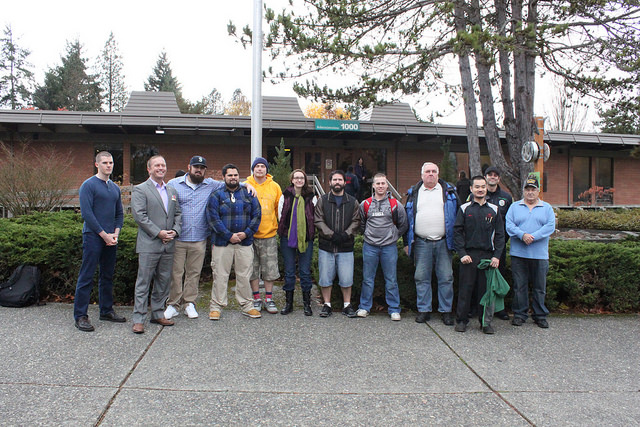
Shoreline Community College veteran students pose for a photo after raising the flags on Veterans Day 2015.

Shoreline Community College veteran students pose for a photo after raising the flags on Veterans Day 2015.

Shoreline Community College has been named a 2016 Best Colleges for Veterans by Military Times. The magazine publishes its list of 175 Best Colleges yearly.

According to Military Times, “schools were evaluated in five categories: academic outcomes/quality, university culture, student support, academic policies and cost and financial aid. While the value of each section was comparable, academic outcomes/quality and university culture were worth the most in the survey, and cost and financial aid was worth the least. Many factors other than those listed in the chart were considered when developing the rankings.”

You can read the article from the Military Times announcing the list here. For Shoreline’s ranking, click here.

Congrats, Shoreline! We’re proud to be a military friendly school!

GAC Presents: The Canada-U.S. Relationship, James Hill, Consul General, Canada, Thurs., Nov. 12

national identities
Join us Thurs., Nov. 12 at 7 p.m. in the PUB Quiet Dining Room (9208) for a talk by James Hill, Consul General, Canada. This event is free and open to the public.

The United States and Canada share two borders and their bilateral relationship is one of the closest and most extensive in the world. It is reflected in the high volume of bilateral trade–more than $2 billion a day in goods and service; the fact that the two countries have one of the world’s largest investment relationships; and in people-to-people contact–about 300,000 people cross between the countries every day. In fields ranging from security and law enforcement to environmental protection to free trade, the two countries work closely together on multiple levels, from federal to local.

Canada and the U.S. cooperate on continental defense, transboundary environmental and water issues, and on international high seas governance initiatives. They are both founding members of the Arctic Council. They are both members of numerous multilateral political, military, and economic fora, including the United Nations, NATO, WTO, NAFTA, G7, G20, the Organization for Security and Cooperation in Europe, the Organization for Economic Cooperation and Development, the Organization of American States, and the Asia-Pacific Economic Cooperation forum.

But do they see eye to eye on every international issue? There is a tendency of Americans to take Canada for granted – “they are just like us, aren’t they?” While the two nations do share many basic values and cooperate in many spheres, Canada does have interests and perspectives that at times are at odds with the United States.

Join us in exploring Canada’s worldview  with the current Consul General of Canada in Seattle, James Hill. See more details on Consul Hill.

For photos, visit and LIKE our Facebook page.
For more info, click here.

A Veterans Day message

Shoreline Community College veteran students pose for a photo after raising the flags on Veterans Day 2015.

Shoreline Community College veteran students pose for a photo after raising the flags on Veterans Day 2015.  Photo gallery

(The following message was emailed to all employees on Nov. 10, 2015.)

Dear Colleagues,

Veterans Day is a time to recognize and remember the sacrifices of our countrymen and women who have served in our armed forces.  Many of our Shoreline colleagues have honorably served our country, and many of our students have served—and continue to serve—with distinction.  I hope each of us will take time during this day to remember their service with respect and reverence.

Having grown up in a military family, I am especially mindful of what our veterans have accomplished.  We all owe a debt of gratitude to them.  

To all veterans: Thank you for what you have given to all Americans.

With heartfelt gratitude,

Cheryl