Reminder! Library Re-Design Employee Forum TODAY at 1:30 p.m.

The ongoing campus refresh project takes another step forward on October 28 with brainstorming/presentation sessions regarding the 4000 Building, also known as the Ray W. Howard Library Media and Technology Center.

The building has undergone some recent usage adjustments. In the spring of 2014, the former TV studio on the lower floor became a black-box theater space used by a variety of digital film, theater and other programs and classes. In the fall of 2014, tutoring services relocated from the 5000 Building (FOSS) to offices on the library main floor. This summer, the Math Learning Center and The Writing and Learning Studio also moved into library main-floor spaces and opened to students for this fall quarter.

A next phase will start with information-gathering sessions facilitated by Seong Shin, Principal for Interior Design Services, along with other personnel at McGranahan Architects of Tacoma. McGranahan is the firm the college has been working with on the campus refresh across campus. The goal is to imagine the look and uses for the building in the coming years.

There are two open sessions scheduled, one for employees and a second for students:

  • All-employees session: 1:30-3 p.m., Oct. 28, Room 1102
  • All-students session: 3:30 – 4:30 p.m. Oct. 28, PUB Main Dining Room

A third session just for those housed in the 4000 Building is set for the morning of Oct. 28.

A separate, student-specific message and survey is being emailed to all students.

And, for those coming to the presentation, McGranahan offers that if anyone has a sketch, image or object represents their thoughts to bring it along and share.

Disability Awareness Month Tip for Oct. 28: Facts About Narcolepsy

narcolepsy
In honor of Disability Employment Awareness Month, the Office of Special Services (OSS) is working to raise awareness of disabilities by offering daily facts and tips about people with disabilities and living with disability. Please take a minute to read and broaden your understanding.

Question: What is Narcolepsy?
Answer:  Narcolepsy is a neurological disorder that impacts 1 in approximately 2,000 people in the United States. Many people are unaware of the condition and go undiagnosed. The disease is a sleep disorder, involving irregular patterns in Rapid Eye Movement (REM) sleep and significant disruptions of the normal sleep/wake cycle. Narcolepsy can affect all areas of a person’s life including relationships with family and friends, education and employment, driving and public outings. While the cause of Narcolepsy is not completely understood, current research points to a combination of genetic and environmental factors that influence the immune system.

Question: What causes Narcolepsy?
Answer:  Scientists have confirmed that Narcolepsy with cataplexy is caused by the loss of the two brain chemicals called hypocretins (orexins). These are neurotransmitters involved in the regulation of the sleep/wake cycle as well as other bodily functions (e.g., blood pressure and metabolism). The cause(s) of Narcolepsy without cataplexy are unknown. Further research is needed to determine why hypocretin cells are destroyed and to identify the exact trigger(s) of both forms of Narcolepsy.

Question: Is Narcolepsy inherited?
Answer: There appears to be some genetic predisposition to developing Narcolepsy with cataplexy, the most common form. About one quarter of the general population in the U.S. carries the HLA-DQB1* o602 genetic marker but only one person out of about 500 of these people will develop this form of Narcolepsy.

Question: Does Narcolepsy affect learning?
Answer: Although Narcolepsy does not affect intelligence, learning is sometimes affected by the symptoms. Study, concentration, memory, and attention span may be periodically impaired by sleep. Adjustments in study/work habits may be continually necessary. This can best be accomplished with the cooperation of school and employer personnel.

Question: How common is Narcolepsy?
Answer: It is estimated that there are over 200,000 persons with Narcolepsy in the United States, but only about 25%, or 50,000 of them, have been diagnosed. On average it takes over seven years from onset of symptoms until a diagnosis is established.

Question: Is Narcolepsy limited to certain groups of people?
Answer: Incidence of Narcolepsy can vary by ethnic group. The highest occurrence is found among the Japanese at one in about 600 and the lowest rate is among Israeli Jews at one in about 500,000.  Narcolepsy affects both men and women equally.

Question: At what age do people get Narcolepsy?
Answer: Although any person can develop Narcolepsy at any age, the typical onset is in the second to third decade (between 10 – 30 years of age) of life.

Question: Can Narcolepsy be cured?
Answer: Currently no cure for Narcolepsy exists, nor any way to replace the missing Hypocretin. Treatment of Narcolepsy aims to relieve the symptoms. The symptoms of Narcolepsy can vary greatly from one person to another, as can the treatments and their effectiveness.

Question: What are the symptoms of Narcolepsy?
Answer:  Narcolepsy has five primary symptoms:

  • Excessive Daytime Sleepiness (EDS) – An overwhelming sense of tiredness and fatigue throughout the day
  • Cataplexy (C) – Events during which a person has no reflex or voluntary muscle control. For example knees buckle and even give way when experiencing a strong emotion – laughter, joy, surprise, anger or heads drop or jaws go slack from the same kind of stimuli
  • Sleep paralysis – A limpness in the body associated with REM sleep resulting in temporary paralysis when the individual is falling asleep, or awakening. Episodes can last from a brief moment to several minutes.
  • Hypnogogic hallucinations – Events of vivid audio and visual events that a person with narcolepsy experiences while falling asleep, or while awakening
  • Disrupted Nighttime Sleep (DNS) – The inability to maintain sleep for more than a few hours at a time.

Other symptoms reported by people with Narcolepsy can include:

  • Automatic Behavior (AB) – The performance of tasks that are often routine, dull or repetitive without conscious effort or memory.
  • Memory Lapses – Difficulty in remembering recent events, actions or words

Question: How is Narcolepsy diagnosed?
Answer: Narcolepsy is diagnosed through a sleep study, a set of medical tests including an overnight Polysomnogram (PSG) and a Multiple Sleep Latency Test (MSLT). Even when cataplexy is clearly present, a sleep study is necessary to rule out sleep apnea and other possible sleep disorders contributing to EDS.

Narcolepsy often takes years to recognize in patients. Many medical conditions result in fatigue, thus physicians might not consider Narcolepsy. While new discoveries are being made about Narcolepsy and other sleep disorders, life with Narcolepsy remains challenging for many people with the condition. Narcolepsy Network hopes that the information, resources, and support provided here on our site and elsewhere through conferences and events will provide people with Narcolepsy both hope and a voice.

Question: How is Narcolepsy treated?
Answer: There are three approaches to treatment:

  • Modern medications
  • Lifestyle adjustments
  • Complimentary or alternative therapy

By combining these approaches and balancing between treatments for Sleepiness and REM Intrusion, optimal control of symptoms can be reached. It is best to be under the care of a physician who is specially trained, Certified in Sleep Medicine, Board Certified in Neurology and experienced in treating Narcolepsy.

The following information and more can be found here and here.

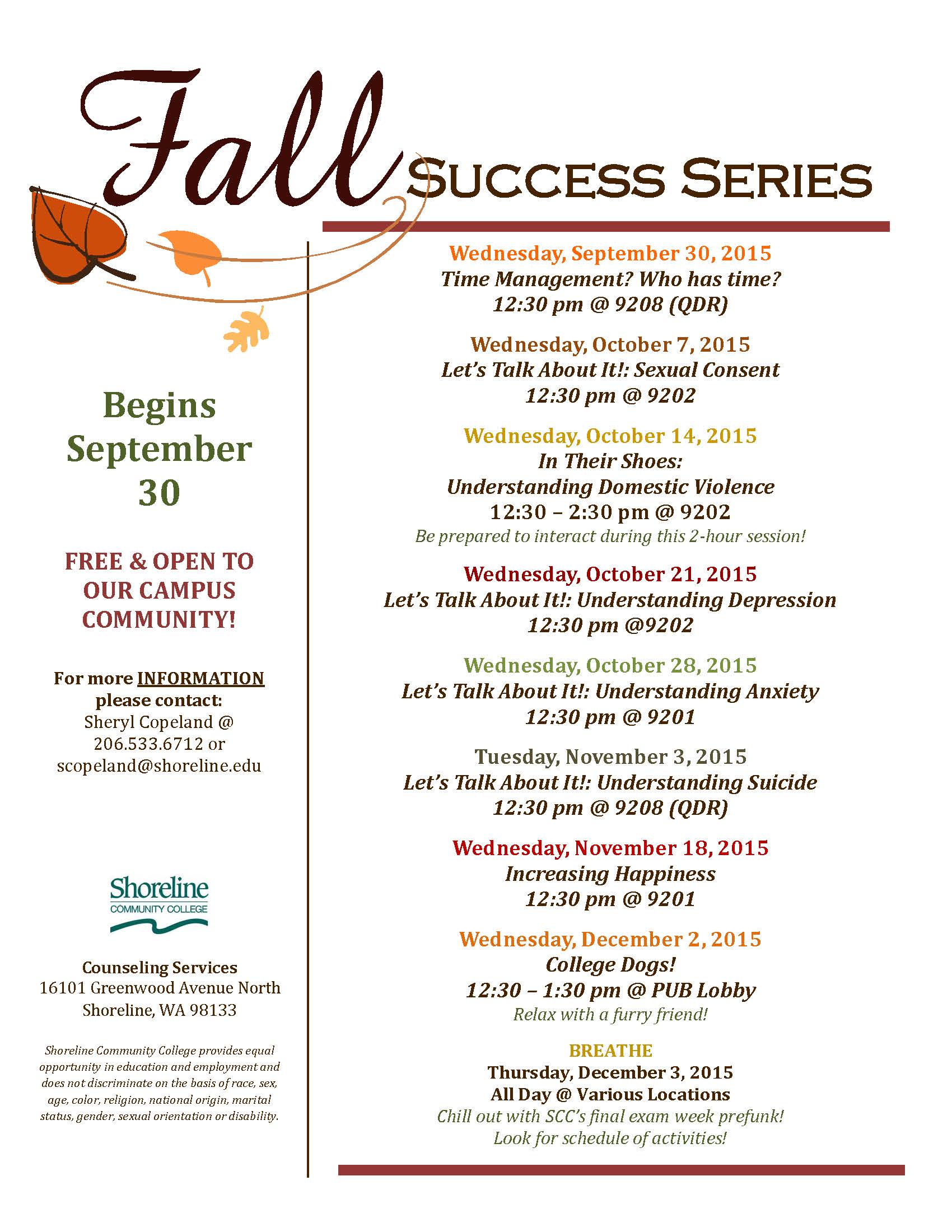
Let’s Talk About It: Understanding Anxiety Workshop, Wed., Oct. 28

Understanding Anxiety
Wednesday, October 28, 2015
12:30 pm in the PUB, room 9201

Anxiety isn’t always a bad thing. In fact, a little anxiety can motivate you and help you stay focused under pressure, such as when taking an exam or driving your car on a dark and stormy night.  However, when anxiety takes over and interferes with daily activities, there may be cause for concern. The good news – recovery is possible and there are many things you can do to get your anxiety in check and regain control of your life.

Join Counseling Services at our interactive workshop and learn more about how to recognize and manage the signs and symptoms of anxiety for yourself or someone you care about.

Workshop is open to all and no RSVP needed. Hope you can make it!

Questions about the workshop? Contact Sheryl Copeland at scopeland@shoreline.edu or 206.533.6712.

Want to know more about anxiety? Visit HelpGuide.org: http://www.helpguide.org/home-pages/anxiety.htm

Need someone to talk to? Stop by Counseling Services in FOSS 5229 or call us at 206.546.4559 to schedule an appointment with a professional counselor. 

Need 24/7 Crisis Support?
King County Crisis Line | 1-866-427-4747 | TTY: 206-461-3219
Snohomish County Crisis Line | 1-800-584-3578 | Online Chat: carecrisischat.org

success series fall _ updated

Disability Awareness Month Tip for Oct. 27: Getting to Know Tourette Syndrome

tourette
In honor of Disability Employment Awareness Month, the Office of Special Services (OSS) is working to raise awareness of disabilities by offering daily facts and tips about people with disabilities and living with disability. Please take a minute to read and broaden your understanding.

What is Tourette syndrome?
Tourette syndrome (TS) is a neurological disorder characterized by repetitive, stereotyped, involuntary movements and vocalizations called tics. The disorder is named for Dr. Georges Gilles de la Tourette, the pioneering French neurologist who in 1885 first described the condition in an 86-year-old French noblewoman.

The early symptoms of TS are typically noticed first in childhood, with the average onset between the ages of 3 and 9 years. TS occurs in people from all ethnic groups; males are affected about three to four times more often than females. It is estimated that 200,000 Americans have the most severe form of TS, and as many as one in 100 exhibit milder and less complex symptoms, such as chronic motor or vocal tics. Although TS can be a chronic condition with symptoms lasting a lifetime, most people with the condition experience their worst tic symptoms in their early teens, with improvement occurring in the late teens and continuing into adulthood.

What are the symptoms?
Tics are classified as either simple or complex. Simple motor tics are sudden, brief, repetitive movements that involve a limited number of muscle groups. Some of the more common simple tics include eye blinking and other eye movements, facial grimacing, shoulder shrugging, and head or shoulder jerking. Simple vocalizations might include repetitive throat-clearing, sniffing, or grunting sounds. Complex tics are distinct, coordinated patterns of movements involving several muscle groups. Complex motor tics might include facial grimacing combined with a head twist and a shoulder shrug. Other complex motor tics may actually appear purposeful, including sniffing or touching objects, hopping, jumping, bending, or twisting. Simple vocal tics may include throat-clearing, sniffing/snorting, grunting, or barking. More complex vocal tics include words or phrases. Perhaps the most dramatic and disabling tics include motor movements that result in self-harm such as punching oneself in the face or vocal tics including coprolalia (uttering socially inappropriate  words such as swearing) or echolalia (repeating the words or phrases of others). However, coprolalia is only present in a small number (10 to 15 percent) of individuals with TS. Some tics are preceded by an urge or sensation in the affected muscle group, commonly called a premonitory urge. Some with TS will describe a need to complete a tic in a certain way or a certain number of times in order to relieve the urge or decrease the sensation.

Tics are often worse with excitement or anxiety and better during calm, focused activities. Certain physical experiences can trigger or worsen tics, for example tight collars may trigger neck tics, or hearing another person sniff or throat-clear may trigger similar sounds. Tics do not go away during sleep but are often significantly diminished.

What is the course of TS?
Tics come and go over time, varying in type, frequency, location, and severity. The first symptoms usually occur in the head and neck area and may progress to include muscles of the trunk and extremities. Motor tics generally precede the development of vocal tics and simple tics often precede complex tics. Most patients experience peak tic severity before the mid-teen years with improvement for the majority of patients in the late teen years and early adulthood. Approximately 10-15 percent of those affected have a progressive or disabling course that lasts into adulthood.

Can people with TS control their tics?
Although the symptoms of TS are involuntary, some people can sometimes suppress, camouflage, or otherwise manage their tics in an effort to minimize their impact on functioning. However, people with TS often report a substantial buildup in tension when suppressing their tics to the point where they feel that the tic must be expressed (against their will). Tics in response to an environmental trigger can appear to be voluntary or purposeful but are not.

What causes TS?
Although the cause of TS is unknown, current research points to abnormalities in certain brain regions (including the basal ganglia, frontal lobes, and cortex), the circuits that interconnect these regions, and the neurotransmitters (dopamine, serotonin, and norepinephrine) responsible for communication among nerve cells. Given the often complex presentation of TS, the cause of the disorder is likely to be equally complex.

What disorders are associated with TS?
Many individuals with TS experience additional neurobehavioral problems that often cause more impairment than the tics themselves. These include inattention, hyperactivity and impulsivity (attention deficit hyperactivity disorder—ADHD); problems with reading, writing, and arithmetic; and obsessive-compulsive symptoms such as intrusive thoughts/worries and repetitive behaviors. For example, worries about dirt and germs may be associated with repetitive hand-washing, and concerns about bad things happening may be associated with ritualistic behaviors such as counting, repeating, or ordering and arranging.  People with TS have also reported problems with depression or anxiety disorders, as well as other difficulties with living, that may or may not be directly related to TS. In addition, although most individuals with TS experience a significant decline in motor and vocal tics in late adolescence and early adulthood, the associated neurobehavioral conditions may persist. Given the range of potential complications, people with TS are best served by receiving medical care that provides a comprehensive treatment plan.

How is TS diagnosed?
TS is a diagnosis that doctors make after verifying that the patient has had both motor and vocal tics for at least 1 year. The existence of other neurological or psychiatric conditions can also help doctors arrive at a diagnosis. Common tics are not often misdiagnosed by knowledgeable clinicians. However, atypical symptoms or atypical presentations (for example, onset of symptoms in adulthood) may require specific specialty expertise for diagnosis. There are no blood, laboratory, or imaging tests needed for diagnosis. In rare cases, neuroimaging studies, such as magnetic resonance imaging (MRI) or computerized tomography (CT), electroencephalogram (EEG) studies, or certain blood tests may be used to rule out other conditions that might be confused with TS when the history or clinical examination is atypical.

It is not uncommon for patients to obtain a formal diagnosis of TS only after symptoms have been present for some time. The reasons for this are many. For families and physicians unfamiliar with TS, mild and even moderate tic symptoms may be considered inconsequential, part of a developmental phase, or the result of another condition. For example, parents may think that eye blinking is related to vision problems or that sniffing is related to seasonal allergies. Many patients are self-diagnosed after they, their parents, other relatives, or friends read or hear about TS from others.

How is TS treated?
Because tic symptoms often do not cause impairment, the majority of people with TS require no medication for tic suppression. However, effective medications are available for those whose symptoms interfere with functioning. Neuroleptics (drugs that may be used to treat psychotic and non-psychotic disorders) are the most consistently useful medications for tic suppression; a number are available but some are more effective than others (for example, haloperidol and pimozide).

Unfortunately, there is no one medication that is helpful to all people with TS, nor does any medication completely eliminate symptoms. In addition, all medications have side effects. Many neuroleptic side effects can be managed by initiating treatment slowly and reducing the dose when side effects occur.

Behavioral treatments such as awareness training and competing response training can also be used to reduce tics. A recent control trial called Cognitive Behavioral Intervention for Tics showed that training to voluntarily move in response to a premonitory urge can reduce tic symptoms. Other behavioral therapies, such as biofeedback or supportive therapy, have not been shown to reduce tic symptoms. However, supportive therapy can help a person with TS better cope with the disorder and deal with the secondary social and emotional problems that sometimes occur.

Is TS inherited?
Evidence from twin and family studies suggests that TS is an inherited disorder. Although early family studies suggested an autosomal dominant mode of inheritance (an autosomal dominant disorder is one in which only one copy of the defective gene, inherited from one parent, is necessary to produce the disorder), more recent studies suggest that the pattern of inheritance is much more complex. Although there may be a few genes with substantial effects, it is also possible that many genes with smaller effects and environmental factors may play a role in the development of TS.

Genetic studies also suggest that some forms of ADHD and OCD are genetically related to TS, but there is less evidence for a genetic relationship between TS and other neurobehavioral problems that commonly co-occur with TS. It is important for families to understand that genetic predisposition may not necessarily result in full-blown TS; instead, it may express itself as a milder tic disorder or as obsessive-compulsive behaviors. It is also possible that the gene-carrying offspring will not develop any TS symptoms.

The gender of the person also plays an important role in TS gene expression. At-risk males are more likely to have tics and at-risk females are more likely to have obsessive-compulsive symptoms.

Genetic counseling of individuals with TS should include a full review of all potentially hereditary conditions in the family.

What is the prognosis?
Although there is no cure for TS, the condition in many individuals improves in the late teens and early 20s. As a result, some may actually become symptom-free or no longer need medication for tic suppression. Although the disorder is generally lifelong and chronic, it is not a degenerative condition. Individuals with TS have a normal life expectancy. TS does not impair intelligence. Although tic symptoms tend to decrease with age, it is possible that neurobehavioral disorders such as ADHD, OCD, depression, generalized anxiety, panic attacks, and mood swings can persist and cause impairment in adult life.

What is the best educational setting for children with TS?
Although students with TS often function well in the regular classroom, ADHD, learning disabilities, obsessive-compulsive symptoms, and frequent tics can greatly interfere with academic performance or social adjustment. After a comprehensive assessment, students should be placed in an educational setting that meets their individual needs. Students may require tutoring, smaller or special classes, and in some cases special schools.

All students with TS need a tolerant and compassionate setting that both encourages them to work to their full potential and is flexible enough to accommodate their special needs. This setting may include a private study area, exams outside the regular classroom, or even oral exams when the child’s symptoms interfere with his or her ability to write. Untimed testing reduces stress for students with TS.

The above information and more can be found by clicking here.

Join Us For The Challenge and Promise of a Multicultural South Africa Wed., Oct. 28

global eyes
This past summer a group of students, led by Professor Ernest Johnson, experienced a 4-week summer program in Cape Town where they examined the social and cultural history of South Africa and explored current efforts to create a democratic, multicultural nation. Students participated in social and historical lectures and tours in Cape Town and the surrounding area.  They also visited high school and elementary school classes, attended lectures by community leaders and supervised home-stays inside “Black” townships and homelands.

For more details about the trip and what students experienced, join us in a conversation with Dr. Johnson Wed., Oct. 28 in the PUB Quiet Dining Room (9208) from 12:30-1:30 p.m.

*This event is co-sponsored by Shoreline Study Abroad, International Education