Campus events for Tues., Feb. 23: The age of mass incarceration, teaching and learning conversation, and more!

These are the events that are happening around campus Tues., Feb. 23.

Advising Day, Advising & Counseling Center, room 5229
Tues., Feb. 23: 10 a.m – 4 p.m.

advisingRegistration for spring quarter begins next week! To prepare for the occasion, general advisors will be available in the in the Advising & Counseling Center to talk with students about:

  • Locating your SID and PIN
  • Determining your assigned registration date
  • Reviewing Educational Plan for next quarter’s course selection
  • Previewing the Class Schedule of course offerings
  • Creating a potential schedule
  • Understanding pre-requisites for course selections
  • Learning about payment options and financial aid

Come grab free snacks, free advice, and check if you are on track to meet your goals!

You can also participate live online. For details, please email Advising Services at advising@shoreline.edu.

Margin to Center: The Age of Mass Incarceration, PUB 9208
Tues., Feb. 23: 12:30-2 p.m.

razor wire
Join us for a discussion on this age of mass incarceration and the ways in which people of color, specifically African Americans, are disproportionately targeted and imprisoned. We will screen a portion of The Central Park Five which is a documentary that tells the story of 5 Black and Latino teenagers who were wrongfully convicted of raping a white woman.

This discussion will be facilitated by Dr. Johnson, professor in the Equity and Social Justice Department, and Rezina Habtemariam, Acting Director of Student Life.

Intramural Zumba, Athletics room 3025
Tues., Feb. 23: 12:35-1:25 p.m.
zumba2
Take time out from your busy day to dance your way fit. Free to students, faculty, and staff.

Teaching & Learning Conversation: Rachel David and Kathie Hunt, Library classroom 4214
Tues., Feb. 23: 1-2 p.m.
Dean of Humanities Kathie Hunt and Professor Rachel David lead a conversation about the very interesting question, How do we know if our unconscious biases affect students, and what can we do about them?

There’s a national conversation about race and power, and there’s a national conversation about community college students and their willingness to engage and ability to succeed.  But there is a smaller conversation that many instructors have with ourselves every day about whether our own understanding of the world helps or hinders our students. Join your colleagues for a safe conversation about a tender topic in order to deepen your teaching practice around student engagement.


Options in Nursing workshop, PUB 9202
Tues., Feb. 23: 1:30-2:30 p.m.
nursing symbol
Are you intending to apply to a nursing program? Come learn about options in nursing professional training. At this session, we will cover:

•Nursing degree levels and titles
•Nursing programs in WA state
•Core nursing prerequisites
•Which degree plan to follow here at Shoreline
•Nursing related experience
•Other helpful transfer tips

Evaluating Sources for Research & Essay Writing, Library Classroom 4214
Tues., Feb. 23: 2-3 p.m.
Evaluating outside sources for an essay or research paper can be vexing!  How do you know if a source is reliable? This workshop will teach you how to evaluate sources so you can join any scholarly conversation with confidence!

Intramural Zumba, Athletics room 3025
Tues., Feb. 23: 5:05-5:50 p.m.
Take time out from your busy day to dance your way fit. Free to students, faculty, and staff.

Bring a problem; solve a problem: Strategies and routines for helping ESL/International Students Succeed

What: Lauren Wilson and Annamaria Winters in collaboration with the English Department will bring strategies you can use to help your ESL/International students succeed in your discipline courses, including ideas about grading, grammar, and classroom management. They will also describe the pathways International students take to get into your courses.

Why: Many discipline instructors have asked for ideas and information to strengthen their approach to instruction for second language speakers. The discipline of TESOL brings methodology and pedagogical approach to your toolbox.

When: Thursday, February 18, 2016 3:00-4:00
Where: PUB 9201
Contact:
Lauren Wilson lwilson@shoreline.edu;
Annamaria Winters awinters@shoreline.edu;
Maya Smorodinsky msmorodin@shoreline.edu
Kate Boyd kboyd2@shoreline.edu
Claire Murata professionalLearning@shoreline.edu  206.546.5820

Productive Persistence Workshop, Thurs., Feb. 4

What is this?  This workshop, offered by Lawrence Morales and Jane Muhich, math professors at Seattle Central, presents usable approaches to helping your students stay the course, build stamina and succeed. While the original work was done with math students, this applies to all students in all disciplines, and Profs. Morales and Muhich have built a large cohort of faculty who have adopted these strategies. Watch this video to learn more!

Where: Shoreline’s campus Room 2201
When: February 4, from 3-4:30 p.m.
Questions? Contact Claire Murata professionalLearning@shoreline.edu

Reminder about Shoreline Early Alert Program

The SEA team would like to remind you of the early alert system called Shoreline Early Alert (SEA). SEA is a referral program designed to help students encountering difficulty in the pursuit of their academic goals by providing academic intervention.

NOTE: Intervention is a process and may not produce immediate results. Our goal is to connect with the student early in the quarter and connect them to the appropriate resources.

SEA is intended to serve ALL (domestic and international) students on campus, so we are excited to announce that Lianne Almughirah, Assistant Director for International Student Success, has joined the SEA Team! (See her bio on the International Education staff page.) Lianne has already been conducting early alert work and support services for International students, but will now be officially a part of the SEA referral process.

Wondering when to refer?

*   Low test scores
*   Unexplained excessive absenteeism or tardiness
*   Pacing in an online class
*   Not doing assignments
*   Financial matters
*   External concerns

If you already reached out to a student about any of the topics above and have not seen a positive change, then using SEA would be a great next step.

It’s Easy to Make a Referral to SEA!
Use the SEA Referral Form rather than sending individual emails. A SEA Team member will respond within 24 hours to both you and the student. SEA is intended to provide academic intervention and support to students in a variety of ways.

Observed or encountered other issues of concern?

*   Crisis management or threat: STAT referral program
*   Personal concerns: Counseling Services
*   Campus emergencies: Safety and Security
*   Classroom policies or academic integrity: contact your Dean or Supervisor
*   Student Conduct: Kim Thompson, kthompson@shoreline.edu, Dean of Student Affairs
*   For life-threating emergencies, dial 911.

Learn more about SEA

View our Referral Form

See our video tutorial

We look forward to continuing to work with you and to support our students!

Submitted by:

Nicole Sunwall, M.Ed.  |  Student Success Coach
FOSS Bldg. 5216  |  T: (206) 546-4542
E: nsunwall@shoreline.edu

From student to project lead: Clean Energy Tech’s Louise Petruzzella

louise pLouise Petruzzella, director of Shoreline’s Clean Energy Technology program, got the following great press in Community College Daily. Congrats, Louise! Keep up the great work!
From student to project lead
by Madeline Patton, Published December 9, 2015
In her first year as the inaugural director of the Clean Energy Technology & Entrepreneurship program atShoreline Community College in Washington, Louise Petruzzella doubled enrollment from 20 to 40 students, reactivated the industry advisory committee and placed all 10 graduates in jobs.

She attributes her accomplishments to several things: a MentorLinks grant, her experience as a graduate of the associate degree program and the subject matter expertise of her five faculty colleagues.

“I have an edge because I was a student in the program,” said Petruzzella, who enrolled in winter 2012 and finished her associate degree in clean energy technology in 2014.

A few other career experiences certainly contributed to Petruzzella maximizing the mentoring, professional development and $20,000 in program development support provided by the MentorLinks grant that theAmerican Association of Community Colleges awarded to her through its Advanced Technological Educationgrant from the National Science Foundation.

“Without MentorLinks, it wouldn’t have been possible. It’s not about the money. It’s about the cachet,” she said.

A new career path

While Petruzzella was a clean energy technology novice before enrolling at Shoreline, her 15 years of teaching philosophy as a part-time instructor at various colleges gave her an unusual perspective of the program’s potential and how to instigate organizational changes to improve it.

IMG_9080

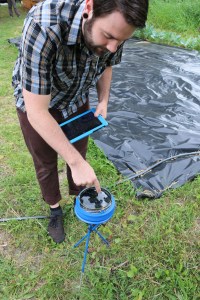
Shoreline Community College students assess a site for a vegan farmer’s solar energy project.

Her experience in construction — having worked for her dad’s general contracting business as a teenager and used home renovation jobs to pay her college tuition — made her acutely aware of the challenges employers face and their expectations for employees.

Ironically, it was her difficulty finding steady employment in both those fields that led her to become a student at Shoreline.

After earning a bachelor’s degree in religious studies and philosophy from University of San Diego and a master’s degree in theological studies from Emory University, Petruzzella taught philosophy as an adjunct faculty member at several colleges, including Metropolitan Community College in Nebraska and Pima Community College in Arizona, where she began her postsecondary education as a transfer student.

When she moved to Washington several years ago, the recession was setting in and she could not find a teaching job. To pay her bills, she went back to construction until she was laid off. When an unemployment office staffer offered retraining, Petruzzella chose the clean energy technology (CET) program at Shoreline.

She liked what she was learning in her CET courses, but was frustrated by the lack of program leadership and structure to help students obtain internships and jobs.

Input from a student’s perspective

“I thought, ‘This is not right. We’re not supporting our students as they need and deserve,’” she explained.

Midway through the program, even as she picked up adjunct teaching assignments (including the CET program), Petruzzella began formulating ways to improve Shoreline’s program and use her unusual skill set. She started talking to anyone on campus who would listen to her. Her message: “You have a potentially wonderful program, but you need someone to run it and I suggest you hire me.”

College administrators were persuaded and started a formal search for the program’s first leader. Shortly after she was hired, Petruzzella and the college’s grant writer completed the MentorLinks grant application. “I already had a vision of what I wanted to happen in the program,” she said.

Kenneth A. Walz, Petruzzella’s MentorLinks mentor, points out that most new faculty members spend their first year getting their bearings, not remaking a program. Walz teaches chemistry and engineering instructor at Madison Area Technical College (MATC) in Wisconsin and is principal investigator of Career Education in Renewable Energy Technologies, an ATE project at MATC.

Petruzzella added three new courses, revised several introductory courses for online delivery, led with Walz a multi-day biofuels workshop for educators, hosted a regional renewable energy industry conference and established partnerships with a neighboring community college and university.

During the second year of the MentorLinks grant, Petruzzella plans to involve the industry advisory committee (which she grew from four to more than 30 members) in a formal curriculum review to shift the program’s focus to high-performance buildings as a state-funded solar energy initiative ends in 2016. She hopes to grow enrollment to 60 students.

“When I say it helped that I was a student in the program, I mean that. I want the success of my students. I saw where the program wasn’t doing what it should be doing for our students. So that’s what really inspires me. To make sure they are getting relevant training, that they are going to be employed, that they are going to have an internship if they want. That’s what’s really driving me,” she said.

Her one-year contract was extended through June 2016 with support from the college’s Innovation Fund, and the ongoing status of the position is currently under consideration.