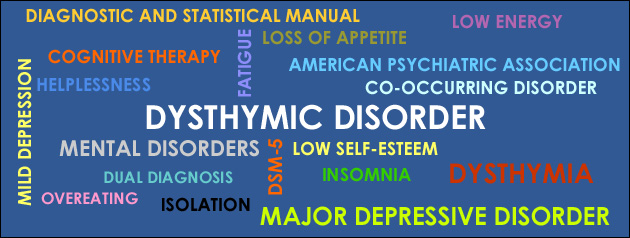
Disability Awareness Month Tip for Oct. 23: Facts About Dysthymia

dysthmia
In honor of Disability Employment Awareness Month, the Office of Special Services (OSS) is working to raise awareness of disabilities by offering daily facts and tips about people with disabilities and living with disability. Please take a minute to read and broaden your understanding.

Facts about Dysthymia
Dysthymia (dis-THIE-me-uh) is a mild but long-term (chronic) form of depression. Symptoms usually last for at least two years, and often for much longer than that. Dysthymia interferes with your ability to function and enjoy life.

With dysthymia, you may lose interest in normal daily activities, feel hopeless, lack productivity, and have low self-esteem and an overall feeling of inadequacy. People with dysthymia are often thought of as being overly critical, constantly complaining and incapable of having fun.

Dysthymia symptoms in adults may include:

  • Loss of interest in daily activities
  • Sadness or feeling down
  • Hopelessness
  • Tiredness and lack of energy
  • Low self-esteem, self-criticism or feeling incapable
  • Trouble concentrating and trouble making decisions
  • Irritability or excessive anger
  • Decreased activity, effectiveness and productivity
  • Avoidance of social activities
  • Feelings of guilt and worries over the past
  • Poor appetite or overeating
  • Sleep problems

In children, dysthymia sometimes occurs along with attention-deficit/hyperactivity disorder (ADHD), behavioral or learning disorders, anxiety disorders, or developmental disabilities. Examples of dysthymia symptoms in children include:

  • Irritability
  • Behavior problems
  • Poor school performance
  • Pessimistic attitude
  • Poor social skills
  • Low self-esteem

Dysthymia symptoms usually come and go over a period of years, and their intensity can change over time. But typically symptoms don’t disappear for more than two months at a time. In general, you may find it hard to be upbeat even on happy occasions — you may be described as having a gloomy personality.

When dysthymia starts before age 21, it’s called early-onset dysthymia. When it starts after that, it’s called late-onset dysthymia.

When to see a doctor
It’s perfectly normal to feel sad or upset sometimes or to be unhappy with stressful situations in your life. But with dysthymia, these feelings last for years and interfere with your relationships, work and daily activities.

Because these feelings have gone on for such a long time, you may think they’ll always be part of your life. But if you have any symptoms of dysthymia, seek medical help. If not effectively treated, dysthymia commonly progresses into major depression. Sometimes, a major depression episode occurs in addition to dysthymia — this is called double depression.

Talk to your primary care doctor about your symptoms. Or seek help directly from a mental health provider. If you’re reluctant to see a mental health professional, reach out to someone else who may be able to help guide you to treatment, whether it’s a friend or loved one, a teacher, a faith leader, or someone else you trust.
The above information and more can be found here and here.

Northwest International Education Association Conference Fri., Oct. 23

NIEW
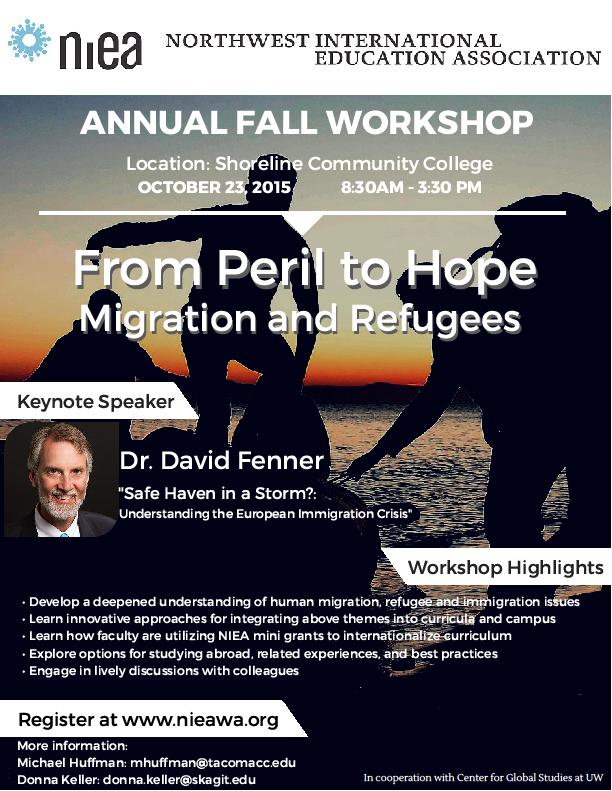
Every year, the Northwest International Education Association (NIEA) sponsors a one-day conference for college faculty, staff and students to learn about current global issues and world events. The theme of the conference builds on the yearly theme of the Community College Master Teacher Institute with world-renowned researchers, discipline-specific experts and community leaders presenting.

This year’s theme is “From Peril to Hope: Migration and Refugees” and it will be held at Shoreline Community College on Fri., Oct. 23 from 8:30 a.m. – 3:30 p.m.

To register, go to: www.nieawa.org

The Office of Special Services Presents the Film FIXED, Mon. Oct. 26

fixed
In honor of Disability Employment Awareness Month, the Office of Special Services (OSS) is working to raise awareness of disabilities by offering a movie screening of FIXED.

FIXED Mon., Oct. 26 from 1-3 p.m. (movie is 60 minutes, with a discussion afterwards for those who can stay) in room 1504.

What is FIXED about??

A haunting, subtle, urgent documentary, FIXED questions commonly held beliefs about disability and normalcy by exploring technologies that promise to change our bodies and mind forever. Told primarily through the perspectives of five people with disabilities: a scientist, journalist, disability justice educator, bionics engineer and exoskeleton test pilot, FIXED takes a close look at the implications of emerging human enhancement technologies for the future of humanity.

Check out the trailer here.

Please contact the Office of Special Services if you have questions or would like to schedule a discussion of the topic or a showing of the movie in your class.

Kathy Cook, Associate Dean
Office of Special Services
Ext. 4544

SCCFT AFTWA Local 1950 on Campus for Part-Time Equity Week, Oct. 26-29

SCCFT AFTWA Local 1950 will recognize Part-Time Faculty at Shoreline Community College during Part-Time Equity Week by hosting a table in the PUB Lobby, 8:30 a.m. – 12:30 p.m. Mon., Oct. 26 through Thurs., Oct. 29.

We wish to say “Thank you” to our Part-Time Faculty and to take this nationally recognized week as an informational/educational opportunity to raise awareness across campus of the inequities faced by part-time faculty, while at the same time recognizing their contributions, talents and presence on campus.  There will be a mini test to see what the campus community knows about part-time faculty, posters with facts/statistics, information about the rights a part-time faculty has under the SCCFT Bargaining Agreement, and offer a few pre-Oct. 31 candy treats.

Please stop by our table in the PUB Lobby, 9000 bldg., and/or volunteer to staff the table for 30 minutes or an hour.  Elizabeth Hanson has a sign-up sheet with some openings. Please email her at elhanson@shoreline.edu or stop by her office 5303 to sign up. 

REMINDER – PARKING ALERT: Large Conference on Campus Fri., Oct. 23

On Fri. Oct. 23, the International Education department will host approximately 100 educators from around the state for a large conference called “From Peril to Hope.” The timeframe will range from 8 a.m. arrivals to 3:30-4 p.m. departures. The primary meeting will be mostly in the PUB Main Dining Room, but then there will be break-out sessions spread around campus. Here are critical things you need to be aware of:

  • Parking is complimentary this day. The six meters will be signed to welcome this association and state parking is complimentary.
  • The guests will park all over campus, so no parking enforcement this date, except in the case of course of illegal parking.
  • There will also be messaging made from IE to their guests that overflow parking is available at the Greenwood and Sears lots. The Sears shuttle will be fully staffed through the peak afternoon hours of 2-4 p.m. in the event some folks park at the Sears lot to take advantage of the extra space there.

Please leave yourself extra time to get to and from campus this day.